Down Payment Assistance (DPA) programs can make homeownership possible for buyers who may have the income and credit needed to qualify for a mortgage but need help covering the down payment, closing costs, or other upfront expenses.
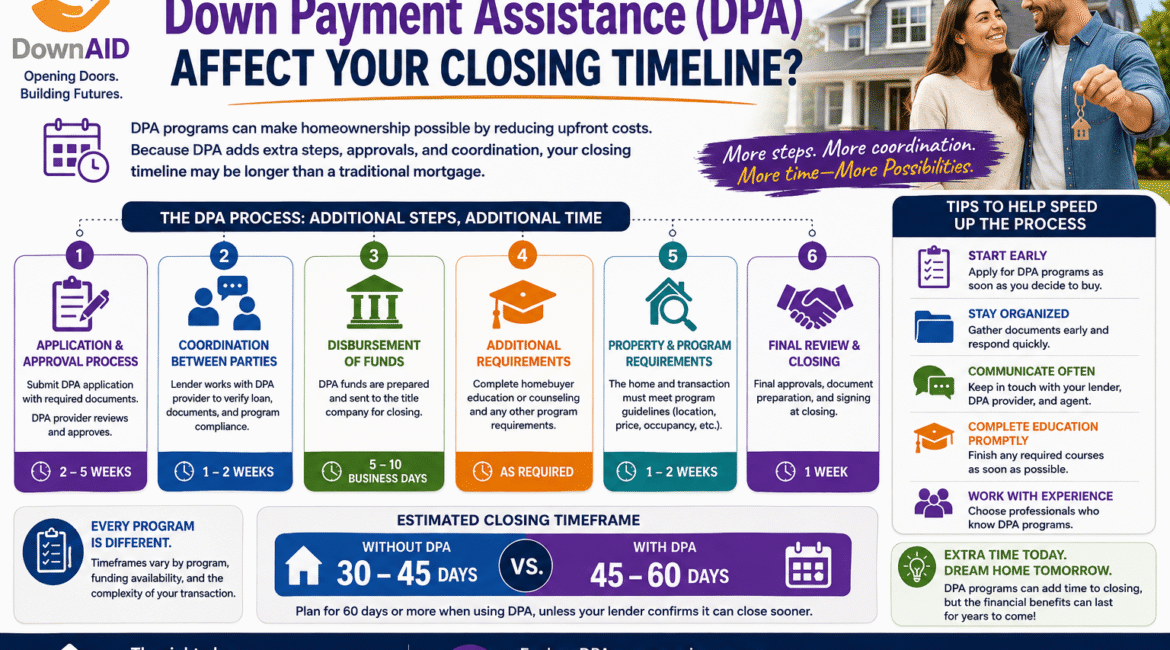
However, there is an important tradeoff buyers should understand: adding a DPA program can add additional steps, approvals, documentation, and parties to the transaction.

A traditional mortgage involves coordination between the borrower, lender, real estate agents, title or closing company, insurance provider, appraiser, and other parties. When DPA is added, there may also be a housing agency, municipality, nonprofit organization, state program administrator, or other DPA provider involved.
For that reason, buyers using DPA should generally plan for a longer closing period and avoid assuming that a transaction can close as quickly as a standard mortgage.

Why Can DPA Take Longer?
The issue usually isn’t the mortgage itself. The additional time comes from satisfying two sets of requirements at the same time:
Mortgage Requirements + DPA Program Requirements
The mortgage lender must approve the borrower and property under the requirements of the underlying loan program, such as FHA, VA, USDA, or conventional financing.
At the same time, the borrower, property, mortgage, and transaction must satisfy the requirements of the DPA program.
Neither approval necessarily replaces the other.
This additional layer of review is one of the primary reasons buyers should discuss their expected closing timeline with an experienced mortgage professional before making an offer on a home.
1. Determining DPA Eligibility Comes First
Before relying on DPA funds, you need to determine whether you and the proposed transaction actually meet the program’s requirements.
Eligibility can depend on factors such as household income, credit score, debt-to-income ratio, property location, purchase price, occupancy, loan type, household size, and whether the borrower meets the program’s definition of a first-time homebuyer.
Some programs may impose additional requirements.
This means that simply qualifying for a mortgage does not automatically mean you qualify for DPA.
Whenever possible, eligibility should be investigated before you enter into a purchase contract. Discovering an eligibility problem after signing a contract can create unnecessary delays or require you to find another source for your down payment.
2. The DPA Application Creates an Additional Approval Process
Once an appropriate program has been identified, a separate DPA application or reservation process may be required.
Depending on the program, borrowers may need to provide income documentation, tax returns, bank statements, identification, household information, purchase contract information, mortgage approval documents, or other supporting documentation.
The DPA administrator may then perform its own review.
This is important because the mortgage lender and DPA provider may be reviewing many of the same documents—but for different purposes.
A delay with either party can affect the entire transaction.
Rather than expecting a universal approval period, buyers should ask their mortgage professional:
How long is this particular DPA program currently taking to approve applications?
Processing times can vary considerably between programs and can change based on funding availability, staffing, application volume, and the complexity of the transaction.
3. Your Mortgage and DPA Must Work Together
One of the more complicated parts of a DPA transaction is coordination.
The assistance cannot simply be added to any mortgage without determining whether the programs are compatible.
The lender may need to verify the DPA’s terms, repayment requirements, lien position, source of funds, documentation, and compatibility with the first mortgage.
For example, DPA might be structured as a grant, forgivable second mortgage, deferred-payment second mortgage, or repayable subordinate loan.
Those differences matter.
The mortgage lender may also need documentation from the DPA provider before the loan can receive final approval.
When experienced professionals are familiar with the program, much of this work can occur simultaneously. When the lender, program administrator, or closing agent is unfamiliar with the program, additional back-and-forth can add time.
4. Homebuyer Education May Be Required
Many DPA programs require borrowers to complete an approved homebuyer education course or counseling session.
This may seem like a small requirement, but waiting until the final days before closing can create an unnecessary problem.
The course may need to be completed through a specific approved provider, and a certificate may need to be submitted before the DPA receives final approval.
The best approach is usually to complete required education as early as the program permits.
Do not wait until closing week unless the program specifically requires it.
5. The Property May Also Have to Qualify
DPA eligibility isn’t always limited to the borrower.
The home itself may need to meet program requirements.
Depending on the particular program, there may be restrictions involving property location, maximum purchase price, property type, occupancy, or other characteristics.
Some programs are geographically restricted to a particular city, county, or designated area.
This makes it important to confirm property eligibility before becoming deeply committed to the transaction whenever possible.
A buyer could qualify financially for assistance but discover that a particular property does not.
6. Funding Availability Can Affect the Transaction
DPA programs do not necessarily have unlimited funds.
Some receive funding periodically, while others operate until their allocated funds have been committed.
Depending on the program, assistance may need to be reserved for a particular borrower or transaction.
That creates an important distinction:
Being eligible for a program does not necessarily mean funds are currently available or reserved for you.
Before making an offer based on DPA, ask whether funding is currently available and what must happen for funds to be officially reserved.
This can be especially important with highly popular programs.
7. DPA Funds Must Be Coordinated With the Closing
Even after the borrower and mortgage have been approved, the DPA funds still need to reach the closing transaction correctly.
The lender, DPA administrator, and settlement or title company may need to coordinate final figures and documentation.
The assistance amount may also affect the Closing Disclosure and other closing documents.
If the DPA is structured as a subordinate mortgage, there may be additional documents that must be prepared, reviewed, signed, and recorded.
A last-minute change to the purchase price, seller credits, loan amount, closing costs, or borrower contribution could potentially require the assistance amount or approval to be reviewed again.
That is another reason DPA transactions benefit from having additional time built into the contract.
How Long Should You Allow to Close With DPA?
There is no universal DPA closing timeframe.
Some well-coordinated DPA transactions can close relatively quickly, while others require considerably more time.
Instead of assuming that every DPA transaction will close within 30 or 45 days, buyers should determine the realistic timeline for the specific program they intend to use.
As a practical planning approach, buyers should consider allowing approximately 60 days or more for a purchase involving DPA unless the lender and DPA administrator have confirmed that the particular program can reliably close sooner.
Why provide extra time?
Because the transaction may involve mortgage underwriting, DPA approval, program compliance, homebuyer education, appraisal requirements, title work, insurance, funding authorization, subordinate financing documents, and final coordination among several different parties.
A longer contract period doesn’t necessarily mean the transaction will take the entire time. It simply provides additional room to address unexpected issues without immediately putting the buyer at risk of missing the contractual closing date.
When DPA is involved, having enough time can be far more valuable than trying to promise the fastest possible closing.
Don’t Wait Until You’re Under Contract to Explore DPA
One of the biggest mistakes a buyer can make is finding a home first and investigating DPA afterward.
A better approach is:
Explore → Qualify → Prepare → Shop → Contract → Close
Before seriously shopping for a home, determine what programs may be available, whether you appear to meet their requirements, what documentation will be needed, whether funding is available, and how much time the program typically requires.
Then your real estate agent can structure an offer with a more realistic closing date.
How Buyers Can Help Prevent DPA Delays
Preparation can make a significant difference.
Start gathering financial documentation early and respond quickly when additional information is requested. Complete homebuyer education requirements promptly, avoid making major financial changes during the mortgage process, and keep your lender informed of changes involving employment, income, assets, debts, or the transaction.
Most importantly, work with professionals who understand DPA.
An experienced mortgage professional can help identify potential problems before they become closing problems and coordinate the mortgage with the assistance program from the beginning.
Faster Isn’t Always Better
When buying a home, buyers naturally want to close as quickly as possible.
But when DPA is involved, the goal shouldn’t simply be the fastest closing—it should be a successful closing.
Trying to force a DPA transaction into an unrealistic timeframe can create unnecessary pressure on the borrower, lender, real estate agents, program administrator, and closing company.
Giving everyone sufficient time to complete the required steps can create a smoother experience and reduce the possibility of last-minute surprises.
The Bottom Line
Down Payment Assistance can provide valuable help toward purchasing a home, but buyers should understand that assistance can introduce another layer of requirements into an already complex transaction.
For many DPA purchases, planning for approximately 60 days or more to close can provide a more realistic starting point, although the actual timeframe depends entirely on the specific program, lender, property, and transaction.
Before signing a purchase contract, speak with a mortgage professional experienced with DPA programs and determine the expected timeline for the assistance you’re considering.
A little additional preparation—and a little additional time—can make the difference between scrambling to meet a closing deadline and moving confidently toward homeownership.
Thinking about using Down Payment Assistance?
Explore available programs, learn how they work, and connect with experienced professionals who can help you understand your options at DownAid.com.
DownAid.com is an informational resource. Program availability, eligibility requirements, assistance amounts, funding, repayment terms, and processing timelines vary by program and may change. Information provided should not be considered a commitment to lend or a guarantee of eligibility or assistance. Verify current program requirements and terms with the applicable program administrator and your mortgage professional.