One of the most common questions homebuyers have about Down Payment Assistance is simple:
“If I receive DPA, do I have to pay it back?”

The answer is: it depends on the program.
Down Payment Assistance (DPA) is not one specific type of financial assistance. The term describes a variety of programs that may help eligible homebuyers with their down payment, closing costs, or other permitted expenses associated with purchasing a home.

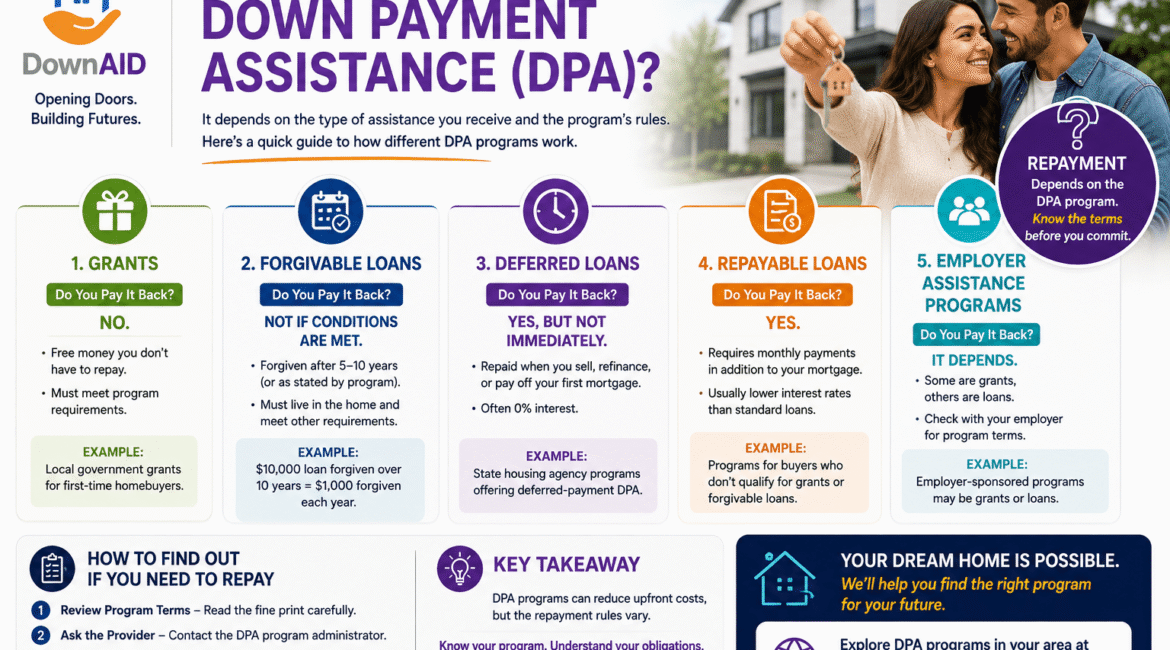
Depending on the program, the assistance could be a grant that doesn’t require repayment, a forgivable loan, a deferred-payment loan, or a loan that requires monthly payments.
That’s why buyers shouldn’t assume that DPA automatically means “free money”—or assume that every DPA program creates another monthly payment.
Understanding exactly what you’re receiving is an important part of deciding whether a particular program makes sense for you.
The Four Common Ways DPA Can Work
Although individual programs vary considerably, many Down Payment Assistance programs fall into four general categories.
1. Grants: Typically No Repayment
A grant is generally the easiest type of DPA to understand.
If you receive assistance structured as a true grant, you typically don’t repay the money, provided you satisfy all applicable program requirements.
For example, a program might provide eligible buyers with funds that can be applied toward the down payment, closing costs, or other permitted expenses.
However, “grant” doesn’t mean “no rules.”
A program may still require the property to be your primary residence, impose income or purchase-price limits, restrict eligible locations or properties, or require completion of homebuyer education.
The important question isn’t simply:
“Is this called a grant?”
You should also ask:
“Are there any circumstances under which these funds could become repayable?”
Always verify the actual program documents.
2. Forgivable DPA Loans: Repayment May Disappear Over Time
Forgivable loans can be especially attractive because the assistance may eventually not have to be repaid.
The key word, however, is forgivable—not automatically forgiven.
A program may provide assistance through a second mortgage or subordinate lien and then forgive some or all of the balance after the borrower satisfies certain requirements.
For example, a program could require you to occupy the property as your primary residence for a specified number of years.
If all conditions are satisfied, the assistance may eventually be completely forgiven.
What Happens If You Sell Early?
This depends entirely on the program.
Some programs gradually forgive the assistance over time. Others may require you to remain in the property for the entire required period before forgiveness occurs.
For illustration, imagine a program provides $10,000 of assistance and forgives $1,000 each year over ten years.
After five years, $5,000 might have been forgiven and $5,000 might remain outstanding.
But another program could use an entirely different structure.
Never assume forgiveness is prorated unless the program specifically says so.
What Could Trigger Repayment?
Depending on the program, repayment could potentially be triggered if you:
- Sell the property before the required period ends.
- Refinance the first mortgage.
- Stop occupying the property as your primary residence.
- Transfer ownership or title.
- Otherwise fail to satisfy the program’s conditions.
The exact rules vary, which makes the program documents extremely important.
3. Deferred-Payment DPA: Pay Later Instead of Now
A deferred-payment loan is different from a forgivable loan.
With deferred DPA, you generally owe the money, but you aren’t required to make regular monthly payments on the assistance right away.
Instead, repayment is postponed until a future event.
Common repayment triggers can include selling the property, refinancing the first mortgage, paying off the first mortgage, transferring the property, or reaching another event specified by the program.
Some deferred loans may carry no interest, while others may accrue interest.
Why Can Deferred DPA Be Helpful?
Imagine receiving $15,000 toward your home purchase without having to add another monthly payment immediately.
That could significantly reduce the cash needed to purchase the property while allowing you to concentrate on your regular mortgage payment and other homeownership expenses.
But the $15,000 hasn’t necessarily disappeared.
If you sell or refinance several years later, you may need to repay the outstanding DPA balance.
This is especially important to understand when considering a future refinance.
4. Repayable DPA Loans: Assistance With Monthly Payments
Some DPA programs provide assistance through a second loan that requires repayment.
In this situation, the assistance helps reduce the amount of cash you need upfront, but you’ll generally have an additional repayment obligation.
The DPA loan may have its own interest rate, term, monthly payment, and repayment conditions.
For example, instead of needing an additional $10,000 or $15,000 in cash to purchase the home, an eligible buyer might receive those funds through a subordinate DPA loan.
The buyer gets help today but repays that assistance over time.
Look Beyond the Amount of Assistance
Receiving more assistance isn’t automatically better.
If one program provides $15,000 but requires monthly repayment while another provides $10,000 that may be forgiven, the smaller assistance amount could potentially be more beneficial over the long term.
You have to compare the entire financial structure, not simply the dollar amount offered.
What About Employer-Sponsored Down Payment Assistance?
Some employers offer homeownership benefits designed to help employees purchase homes.
Employer-assisted housing programs can take several forms.
Assistance could potentially be structured as a grant, forgivable loan, repayable loan, matched-savings benefit, or another form of financial assistance.
Some programs may also require you to remain employed with the company for a particular period.
Because employer programs can vary significantly, ask exactly what happens if you leave the employer, sell the property, refinance, or otherwise fail to satisfy the program requirements.
Does DPA Always Create a Second Mortgage?
No.
A grant may not create a repayable second mortgage at all.
Other forms of DPA, however, may be secured by the property through a subordinate lien or second mortgage.
This distinction matters because a second mortgage can potentially affect what happens when you later sell or refinance the property.
Before closing, make sure you understand whether your assistance will create a lien against your home and what is required to satisfy or release that lien in the future.
What Happens to DPA When You Sell Your Home?
Again, it depends on the structure.
With a true grant, there may be nothing to repay once all program requirements have been satisfied.
With a forgivable loan, the amount owed could depend on how much has already been forgiven.
With deferred assistance, the remaining balance may become due when the property is sold.
With a repayable loan, the outstanding balance would generally need to be addressed as part of the sale.
This is why borrowers should understand the DPA’s exit requirements before entering the program.
Don’t wait until you’re ready to sell the house to discover what happens to the assistance.
What Happens If You Want to Refinance?
This is another important question that buyers sometimes overlook.
If your DPA creates a second mortgage or lien, refinancing the first mortgage later could require additional steps.
Depending on the program, the DPA provider might permit the existing assistance to remain in place, require certain documentation or approval, require subordination, or require repayment.
A future refinance could therefore be affected by the DPA agreement.
If you think you may refinance in the future, ask about this before accepting the assistance.
Is Forgivable DPA Really “Free Money”?
It can eventually function that way if all forgiveness requirements are satisfied, but describing every forgivable DPA program as simply “free money” can be misleading.
Until the assistance has actually been forgiven according to the program’s rules, there may still be conditions attached.
A better way to think about it is:
“Assistance that may not have to be repaid if I satisfy the program requirements.”
That distinction can prevent unpleasant surprises later.
Questions to Ask Before Accepting DPA
Before choosing a program, make sure you can answer several important questions.
How much assistance am I receiving?
Is it a grant, forgivable loan, deferred loan, or repayable loan?
Will there be a second mortgage or lien on my property?
Does the assistance accrue interest?
Will I have a monthly payment?
When does repayment become due?
If it’s forgivable, how and when is it forgiven?
What happens if I sell the home early?
What happens if I refinance?
What happens if the property is no longer my primary residence?
Are there any restrictions on transferring ownership?
Are there additional fees or costs associated with the program?
Those answers are much more important than simply asking how much assistance is available.
Compare the Cost of DPA With Your Other Options
Down Payment Assistance can provide tremendous value, particularly when it allows a qualified buyer to purchase a home sooner without exhausting their savings.
But assistance should still be evaluated as part of the entire mortgage transaction.
A DPA option could potentially affect your interest rate, monthly payment, closing costs, future refinancing flexibility, or total borrowing costs.
For example, a program offering a large amount of assistance isn’t necessarily the best option if it results in significantly higher costs over the time you expect to own the home.
The goal should be to determine:
How does this program affect me today, every month, and when I eventually sell or refinance?
Don’t Choose DPA Based Only on the Word “Free”
Marketing language can make assistance sound simple.
The actual program documents determine your obligations.
Two programs advertising the same amount of assistance could have completely different structures.
One could be a grant.
Another could be a forgivable second mortgage.
A third could be deferred until you sell.
A fourth could require monthly payments.
The assistance amount may look identical while the long-term financial consequences are very different.
Work With Someone Who Understands DPA
DPA programs can involve requirements from multiple parties, including the first-mortgage lender and the organization providing the assistance.
Working with a mortgage professional experienced with Down Payment Assistance can help you understand how different programs interact with your mortgage and what obligations may remain after closing.
You can also confirm specific program requirements directly with the DPA administrator or an approved housing counselor.
The important thing is to understand the details before signing your final documents.
The Bottom Line: Do You Have to Pay Back DPA?
Sometimes yes. Sometimes no.
It depends entirely on the assistance you’re receiving.
A grant generally does not require repayment when its requirements are satisfied.
A forgivable loan may eventually require no repayment if you meet all forgiveness conditions.
A deferred loan generally must be repaid later when a specified event occurs.
A repayable DPA loan generally requires repayment according to its loan terms.
There is no single repayment rule that applies to every Down Payment Assistance program.
Before deciding whether a DPA program is right for you, understand exactly what you’re receiving, what obligations come with it, and what could trigger repayment in the future.
The best DPA isn’t necessarily the program offering the most money. It’s the program whose benefits, costs, requirements, and long-term obligations fit your homeownership goals.
Explore Down Payment Assistance programs and learn more about the options that may be available in your area at DownAid.com.
DownAid.com is an informational resource and does not determine program eligibility or provide the underlying DPA financing. DPA availability, funding, assistance amounts, repayment requirements, forgiveness provisions, interest rates, eligibility standards, and other terms vary by program and can change. Always verify current terms with the applicable program administrator and your mortgage professional before making financial decisions.