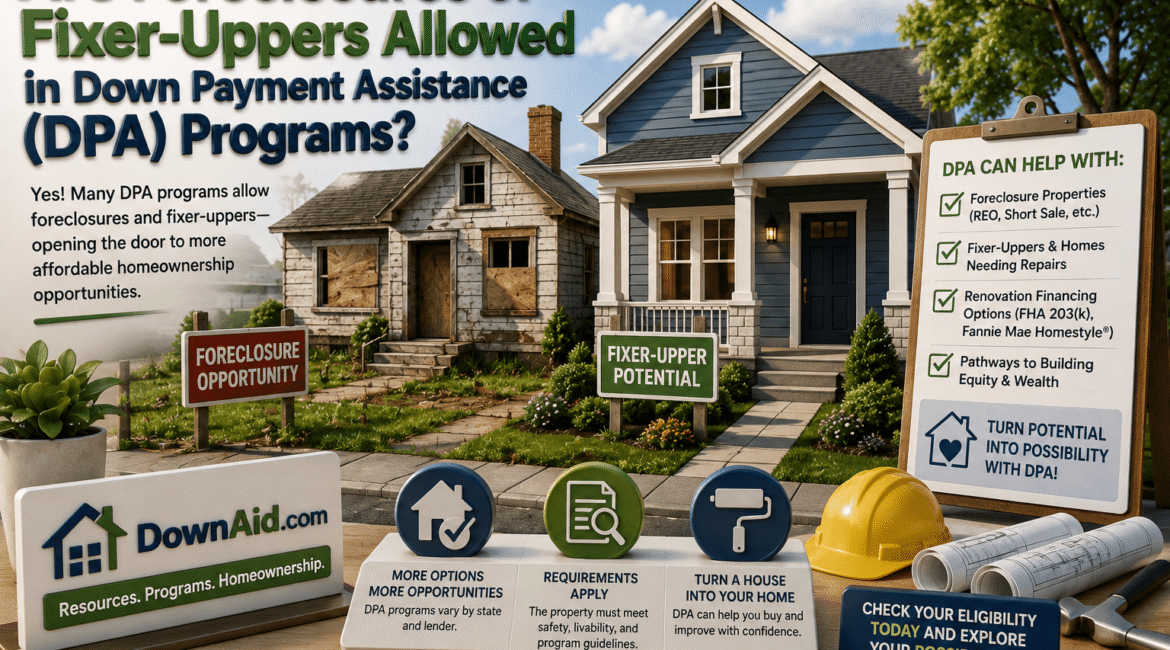
Down Payment Assistance (DPA) programs can help qualified homebuyers overcome one of the largest barriers to homeownership: the upfront money needed to purchase a home.
But what happens when the home you’re interested in isn’t a traditional move-in-ready property?

Maybe you’ve found a foreclosure at an attractive price.
Or perhaps you’ve found a fixer-upper that needs repairs but has tremendous potential.

A common question is:
“Can I still use Down Payment Assistance to buy it?”
The answer is:
Potentially—but the condition of the property, the first mortgage you’re using, and the rules of the specific DPA program all matter.
A foreclosure isn’t automatically disqualified simply because it’s a foreclosure.
Likewise, a home that needs repairs isn’t automatically ineligible simply because it isn’t perfect.
The real question is whether the entire transaction satisfies the requirements of:
The First Mortgage + The DPA Program + The Property
All three pieces have to work together.
Foreclosure and Fixer-Upper Don’t Mean the Same Thing
This is an important distinction.
A foreclosure generally describes the ownership or sale circumstances surrounding a property.
A fixer-upper describes the property’s physical condition.
A foreclosure could be in excellent condition.
A traditional seller-owned home could need extensive repairs.
Therefore, lenders and DPA programs generally aren’t evaluating only the label attached to the property.
They need to determine whether the home and transaction satisfy their requirements.
Can You Use DPA to Purchase a Foreclosure?
Potentially, yes.
There isn’t a universal rule saying that a foreclosed property cannot be purchased with Down Payment Assistance.
If the property satisfies the requirements of the first mortgage and the particular DPA program, a foreclosure may potentially qualify.
For example, HUD specifically identifies eligible HUD Homes/Real-Estate Owned properties among the acceptable property types for FHA’s 203(k) rehabilitation mortgage program.
However, DPA programs can establish their own property restrictions.
So the fact that your mortgage permits a particular property doesn’t automatically mean your DPA program will.
The Bigger Issue Is Usually the Condition of the Property
When buying a foreclosure, the property’s condition can become more important than the fact that the property was foreclosed.
Some foreclosed properties are well maintained.
Others may have:
Missing appliances
Damaged flooring
Roof problems
Broken windows
Plumbing leaks
Electrical problems
Nonfunctioning HVAC systems
Water damage
Mold or moisture issues
Structural problems
Health or safety concerns
Deferred maintenance
The more significant the condition issues become, the more likely they are to affect financing.
Why Property Condition Matters With DPA
DPA doesn’t normally replace the requirements of your first mortgage.
If you’re using an FHA mortgage, the property still needs to satisfy applicable FHA requirements.
If you’re using conventional financing, the property must satisfy the requirements applicable to that conventional mortgage.
The same principle applies to other mortgage programs.
Then the DPA provider may impose additional requirements of its own.
That means a buyer could qualify financially for both the mortgage and DPA but still have a problem because of the property.
Think of qualification as three separate questions:
Does the buyer qualify?
Does the mortgage qualify?
Does the property qualify?
You need a “yes” to all three.
Can You Use DPA on a Fixer-Upper?
Potentially.
The important question is:
How much fixing does the property actually need?
There’s an enormous difference between a home that needs:
Paint
New flooring
Updated cabinets
New appliances
Cosmetic improvements
and one that has:
A failing roof
Major electrical problems
Structural damage
Unsafe conditions
Serious plumbing problems
Extensive water damage
A nonfunctional kitchen or bathroom
The first property may potentially qualify for ordinary mortgage financing.
The second could require specialized renovation financing.
Cosmetic Repairs vs. Required Repairs
This distinction is critical.
A home doesn’t necessarily need to look new to qualify for financing.
Ugly carpet isn’t necessarily the same thing as an unsafe floor.
Outdated kitchen cabinets aren’t necessarily the same thing as a kitchen that cannot function.
Old paint isn’t necessarily the same thing as a condition creating a health or safety concern.
A buyer may look at a home and say:
“This house needs $30,000 of work.”
But the lender might determine that most of those improvements are optional upgrades rather than repairs required for financing.
Alternatively, a relatively inexpensive problem could prevent ordinary financing if it affects safety, soundness, structural integrity, or another applicable property requirement.
The dollar amount isn’t always what determines whether a property qualifies. The nature of the problem matters.
What Happens If the Property Doesn’t Meet Normal Loan Requirements?
This doesn’t necessarily mean the transaction is over.
It may mean you need a different type of mortgage.
Several renovation mortgage products are specifically designed to allow eligible buyers to purchase homes that require improvements.
Instead of financing only the property in its current condition, renovation financing may allow eligible repair costs to be incorporated into the mortgage transaction.
This can create an entirely different path for a fixer-upper.
FHA 203(k): One Possible Fixer-Upper Solution
FHA’s 203(k) Rehabilitation Mortgage Insurance Program is specifically designed to combine the purchase or refinance of a property with rehabilitation financing.
Rather than obtaining one mortgage to purchase the home and then trying to find separate financing for repairs, eligible borrowers can finance the acquisition and rehabilitation through one insured mortgage.
HUD currently provides two general versions:
Limited 203(k) for qualifying smaller repairs and improvements.
Standard 203(k) for more extensive rehabilitation.
This can make FHA 203(k) particularly interesting when a property cannot qualify for ordinary FHA financing in its current condition.
But there is another question:
Can your DPA program be combined with FHA 203(k)?
That depends on the DPA program.
Never assume that because a DPA works with a standard FHA loan, it automatically works with FHA 203(k).
Conventional Buyers Have Renovation Options Too
FHA isn’t the only possible path.
Fannie Mae’s HomeStyle Renovation mortgage allows eligible borrowers to purchase a property and include financing for repairs, remodeling, renovations, or energy improvements in the mortgage.
One particularly important feature is that Fannie Mae states the property does not have to be habitable at the time of closing under HomeStyle Renovation. When the property is uninhabitable, qualifying housing payments during renovation may potentially be financed under applicable requirements.
That can create opportunities for properties that wouldn’t work with a standard conventional mortgage.
Again, however:
The renovation mortgage and DPA program must be compatible.
Newer Conventional Options May Expand the Possibilities
Renovation financing continues to evolve.
Fannie Mae’s current HomeStyle Refresh framework permits eligible improvements in conjunction with standard Guide products and specifically includes down payment assistance programs among the features with which eligible improvements may be used.
That doesn’t mean every individual DPA provider automatically accepts the transaction.
It does demonstrate why buyers shouldn’t assume that needing repairs automatically eliminates DPA.
The specific financing structure needs to be researched.
USDA May Also Permit Purchase-and-Repair Transactions
For eligible rural properties and qualifying borrowers, USDA’s Single Family Housing Guaranteed Loan Program also provides for repairs and rehabilitation associated with the purchase of an existing dwelling.
USDA describes a structure that can allow qualifying borrowers to finance both acquisition and eligible rehabilitation through the purchase transaction.
As with FHA and conventional renovation products, DPA compatibility must still be confirmed separately.
Can DPA Pay for the Repairs?
Sometimes—but don’t assume it can.
A DPA program might permit assistance to be used for:
Down payment
Closing costs
Prepaid expenses
or another specifically authorized purpose.
That doesn’t necessarily mean unused DPA funds can simply be redirected toward remodeling the property.
If repairs need to be financed, they may need to be handled through an eligible renovation mortgage, repair escrow, seller repair, or another approved structure.
The DPA administrator and lender need to determine how the funds may legally be used.
What If the Seller Agrees to Make the Repairs?
This can sometimes solve a property-condition problem.
If the seller agrees to complete required repairs before closing, the lender may be able to verify that the work has been completed and proceed with the transaction.
But foreclosures can create an additional challenge.
Banks, government agencies, and other institutions selling foreclosed properties frequently sell them “as-is.”
The seller may have little or no interest in completing repairs.
That can make renovation financing more important.
What Does “As-Is” Really Mean?
Buyers sometimes assume that an “as-is” sale means the property can’t be financed.
That’s not necessarily true.
“As-is” generally means the seller isn’t agreeing to make repairs.
It doesn’t automatically mean the property is unfinanceable.
If the home already satisfies the applicable mortgage requirements, the buyer may potentially purchase it without requiring the seller to repair anything.
The problem occurs when the property has conditions that must be corrected before ordinary financing can proceed.
If the seller refuses to fix them, the buyer may need another financing solution.
The Appraisal Can Become Very Important
When financing a foreclosure or fixer-upper, the appraisal can do more than establish value.
Depending on the mortgage program, the appraisal may identify conditions that require additional review or repair.
This is particularly important because buyers shouldn’t assume:
“The house is cheap, so the condition doesn’t matter.”
A low purchase price doesn’t eliminate property requirements.
The property still needs to satisfy the applicable financing standards—or the transaction needs to use financing specifically designed to address the repairs.
Appraisal and Home Inspection Are Not the Same Thing
This distinction is also important for buyers.
An appraisal is primarily performed for the mortgage transaction and determines value while addressing applicable property considerations.
A home inspection is generally performed for the buyer to provide a more detailed understanding of the home’s physical condition.
One does not necessarily replace the other.
With a foreclosure or fixer-upper, obtaining appropriate inspections can be particularly valuable because the seller may have limited knowledge of the property’s history.
Be Careful With Utilities That Are Turned Off
Foreclosed properties sometimes have electricity, water, or gas turned off.
That can create challenges when the appraiser, inspector, lender, or other professional needs to verify that certain systems function properly.
Getting utilities activated may require coordination with the property owner or asset manager.
This is another reason foreclosure transactions can sometimes take longer than traditional purchases.
What About Major Structural Problems?
Major structural issues don’t necessarily make a property impossible to purchase, but they can substantially narrow the available financing options.
A property requiring significant structural rehabilitation may need a specialized renovation mortgage rather than ordinary financing.
For example, HUD’s Standard 203(k) program is designed to support major rehabilitation and structural improvements under applicable requirements.
The buyer should work with a lender experienced with renovation financing before committing to the transaction.
Don’t Forget the DPA’s Own Property Restrictions
This is one of the easiest mistakes to make.
Imagine that your lender says:
“Yes, we can finance this fixer-upper.”
That’s excellent—but you’re only halfway there.
You also need to ask:
“Will my DPA program allow it?”
A DPA program may establish rules regarding:
Eligible property types
Property condition
Maximum purchase price
Appraised value
Geographic location
Occupancy
Renovation financing
Inspection requirements
Closing timeline
Required borrower contribution
Maximum combined loan-to-value
Other financing
Until both the lender and DPA administrator approve the structure, don’t assume the assistance will work.
Foreclosures May Require More Time
Another consideration is your closing timeline.
DPA transactions can already involve additional approvals and coordination.
A foreclosure can add another layer.
A renovation mortgage can add yet another.
Now you may have:
Mortgage Underwriting + DPA Approval + Foreclosure Seller Requirements + Renovation Review
That can be significantly more complicated than purchasing a move-in-ready home from a traditional seller.
If renovation financing is involved, contractors, repair estimates, plans, permits, appraisals, and additional documentation may also be required.
For that reason, buyers should discuss a realistic closing period before making the offer.
The Cheapest House Isn’t Always the Cheapest Home
A foreclosure or fixer-upper may have an attractive purchase price.
But buyers need to evaluate the total cost of ownership.
Imagine two properties:
Home A: $300,000 and move-in ready.
Home B: $250,000 but requires $70,000 of rehabilitation.
Home B isn’t necessarily the less expensive option.
In addition to repairs, you may face:
Renovation financing costs
Inspections
Permits
Contractor expenses
Temporary housing
Insurance considerations
Unexpected repairs
Contingency reserves
Longer closing periods
The correct comparison is not simply purchase price versus purchase price.
It’s:
Purchase Price + Financing + Repairs + Time + Risk
Fixer-Uppers Can Also Create Opportunity
There is another side to the equation.
A property that needs work may allow a buyer to purchase in a neighborhood that would otherwise be outside their budget.
Renovations may also improve the home’s functionality and potentially its value.
Fannie Mae’s HomeStyle Renovation program, for example, uses an “as-completed” value as part of determining applicable renovation financing.
That means the transaction can consider what the property is expected to be worth after eligible improvements are completed.
For the right buyer, that can create an opportunity to turn an overlooked property into a long-term home.
Could DPA + Renovation Financing Be a Powerful Combination?
Potentially.
Consider an eligible buyer who has enough income to afford a mortgage but limited savings.
They find a property at an attractive price that needs repairs.
A compatible structure might potentially involve:
Down Payment Assistance → Helps address eligible upfront costs
Renovation Mortgage → Finances eligible property improvements
First Mortgage → Finances the home purchase
Instead of requiring the buyer to provide both a large down payment and tens of thousands of dollars for renovations out of pocket, the financing structure may make the transaction more manageable.
But this is more complicated than a standard purchase.
The programs need to be designed to work together.
What About HUD Homes?
HUD specifically lists HUD Homes/Real-Estate Owned properties among the acceptable property types for FHA 203(k) financing.
This can be particularly relevant when a HUD-owned property requires repairs.
However, buyers still need to satisfy the requirements of the mortgage, property, and any DPA program being used.
A HUD foreclosure being eligible for 203(k) financing doesn’t automatically guarantee DPA eligibility.
Should a First-Time Homebuyer Purchase a Fixer-Upper?
That depends on the buyer.
A fixer-upper can offer tremendous opportunity, but first-time buyers should understand what they’re taking on.
Ask yourself:
Can I handle unexpected repairs?
Do I understand the renovation process?
Can I tolerate delays?
Do I have emergency savings after closing?
Do I understand contractor management?
Where will I live if the home isn’t immediately habitable?
What happens if repairs cost more than expected?
Am I buying the property because it genuinely makes financial sense—or simply because the purchase price looks low?
DPA can reduce your upfront burden.
It doesn’t eliminate the risks of owning a property that needs substantial work.
Questions to Ask Before Making an Offer
If you’re considering a foreclosure or fixer-upper while using DPA, speak with your mortgage professional before signing the contract.
Ask:
Does my DPA program allow foreclosures?
Does it allow properties requiring repairs?
Does the property currently qualify for the mortgage I intend to use?
If not, can I use renovation financing?
Is my DPA compatible with FHA 203(k), HomeStyle Renovation, HomeStyle Refresh, or another renovation product?
Can the DPA be used toward repair costs, or only toward eligible down payment and closing expenses?
Are contractor estimates required before closing?
Does the program require additional inspections?
Will the seller permit utilities to be activated?
How much additional time should we allow to close?
Are there contingency-reserve requirements?
What happens if renovation costs exceed the original estimate?
The answers can determine whether the property is a great opportunity or a transaction that simply won’t work with your financing.
Don’t Fall in Love With the Property Before Checking the Financing
This is particularly important with foreclosures.
A buyer might see a home listed substantially below neighboring properties and immediately think:
“This is the deal I’ve been waiting for.”
Maybe it is.
But before making an offer, determine:
Can you finance it?
Can your DPA be used?
How much will repairs cost?
What will the property be worth after repairs?
How much cash will you still need?
How long will the process take?
An inexpensive property that can’t work with your financing isn’t really a bargain for you.
The Bottom Line
Can you use Down Payment Assistance to purchase a foreclosure or fixer-upper?
Potentially, yes.
A foreclosure isn’t automatically disqualified simply because it was foreclosed.
And a fixer-upper isn’t automatically disqualified simply because it needs work.
The determining factors are usually the condition of the property, the requirements of your first mortgage, the DPA program’s rules, and whether an appropriate renovation-financing option is available when necessary.
A move-in-ready foreclosure might potentially work with ordinary financing and DPA.
A property needing substantial repairs might require specialized financing such as FHA 203(k), Fannie Mae HomeStyle Renovation, or another eligible rehabilitation product.
And the DPA program must permit the financing structure you’re using.
Don’t automatically walk away from a home because it needs work—but don’t assume DPA will make every fixer-upper financeable either.
The right property, the right renovation mortgage, and the right DPA program may create an opportunity that other buyers overlook.
Before making an offer, work with a mortgage professional experienced with both DPA and renovation financing to determine whether the property and assistance program can work together.
Explore Down Payment Assistance programs and learn more about potential homebuying opportunities at DownAid.com.
*DownAid.com is an informational resource and does not determine program eligibility, property eligibility, or provide the underlying DPA or mortgage financing. DPA availability, property-condition