When purchasing a home with Down Payment Assistance (DPA), buyers often focus on one question:
“How much assistance can I receive?”

But there is another important question that could have a major impact on how much money you ultimately need at closing:
“Can I receive Down Payment Assistance AND have the seller contribute toward my closing costs?”

In many situations, yes.
A buyer may potentially combine a DPA program with allowable seller contributions, provided the DPA program, underlying mortgage, purchase contract, and transaction all permit the combination.
This can be extremely valuable because DPA and seller contributions can serve different purposes.
For example:
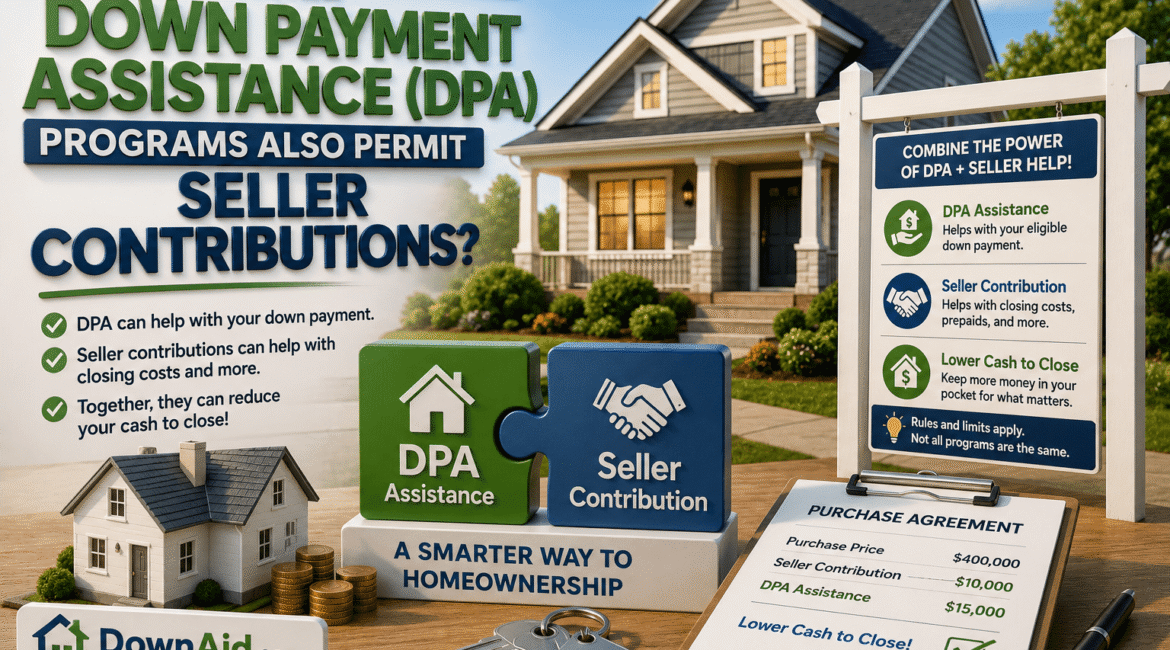
DPA may help with your down payment.
Seller contributions may help with allowable closing costs, prepaid expenses, or discount points.
When properly structured, combining the two can significantly reduce the amount of cash a qualified buyer needs to bring to closing.
However, there are limits and rules that need to be understood before negotiating the transaction.
What Is a Seller Contribution?
A seller contribution—often addressed under mortgage guidelines as an interested party contribution or financing concession—occurs when the seller agrees to pay certain expenses that would otherwise normally be paid by the buyer.
Rather than reducing the purchase price, the seller agrees to contribute an agreed-upon amount toward eligible costs associated with the buyer’s transaction.
For example, imagine you’re purchasing a home for $400,000.
Your mortgage and DPA combination addresses your required down payment, but you still have thousands of dollars in closing costs and prepaid expenses.
As part of the purchase negotiations, the seller might agree to contribute $10,000 toward allowable buyer closing costs.
That $10,000 doesn’t necessarily become cash in your pocket.
Instead, it is generally applied at closing toward eligible expenses.
DPA and Seller Contributions Are Not the Same Thing
This distinction is extremely important.
Down Payment Assistance typically comes from an eligible assistance provider and may be structured as a grant, forgivable loan, deferred-payment loan, or repayable subordinate loan.
Seller contributions come from the seller or another interested party and are generally used for eligible transaction expenses according to the rules of the mortgage program.
Therefore, a buyer could potentially have:
First Mortgage + DPA + Seller Contribution
all working together in the same transaction.
But each component has to satisfy its own rules.
What Can Seller Contributions Usually Pay?
Depending on the mortgage program and transaction, allowable seller contributions may potentially be used toward items such as:
Closing costs
Prepaid property taxes
Homeowners insurance premiums
Escrow account funding
Mortgage-related fees
Title and settlement expenses
Permitted discount points
Allowable interest-rate buydowns
Other eligible borrower-paid costs
Exactly what can be paid depends on the mortgage program and lender requirements.
The seller generally cannot simply hand the buyer unused contribution money after closing.
Can the Seller Pay Your Down Payment?
This is where buyers need to understand an important distinction.
A seller contribution is generally not the same thing as the buyer’s required down payment.
For example, Fannie Mae specifically states that interested party contributions cannot be used to make the borrower’s down payment, satisfy reserve requirements, or meet a minimum borrower contribution requirement.
FHA similarly prohibits interested party contributions from being used to satisfy the borrower’s Minimum Required Investment.
Therefore, a transaction might look something like this:
DPA → Helps satisfy eligible down payment requirements
Seller Contribution → Helps cover allowable closing costs and prepaid expenses
That combination can be much more powerful than either source by itself.
How Much Can a Seller Contribute?
The maximum seller contribution depends heavily on the underlying mortgage program.
There is not one universal seller-contribution percentage for every mortgage.
FHA Loans
Under current FHA guidelines, interested parties may contribute up to 6% of the sales price toward allowable origination fees, closing costs, prepaid items, discount points, and certain other permitted expenses.
However, the contribution cannot be used to satisfy the borrower’s required minimum investment.
Contributions exceeding applicable limits or actual allowable costs can create additional issues under FHA’s inducement-to-purchase rules.
Conventional Loans
Conventional financing can have different contribution limits depending on factors such as occupancy and loan-to-value ratio.
Under current Fannie Mae guidelines for a principal residence or second home, maximum financing concessions generally range from 3% to 9%, depending on the LTV/CLTV.
For example, a principal residence with an LTV/CLTV above 90% generally has a maximum financing concession of 3%, while lower-LTV transactions may permit higher percentages.
The specific mortgage structure therefore matters.
VA and USDA Loans
VA and USDA financing have their own rules regarding seller-paid expenses and concessions.
If DPA is being combined with one of these mortgage programs, the lender should determine the contribution limits and eligible uses under the applicable program.
Never assume that a seller-contribution limit from one mortgage program applies to another.
The Seller Contribution Cannot Exceed What You Can Actually Use
Suppose your mortgage allows a seller contribution of up to $12,000.
That doesn’t necessarily mean you should automatically negotiate $12,000.
Imagine your eligible closing costs, prepaid expenses, and other allowable items total only $8,000.
Depending on the mortgage rules, you generally can’t simply receive the unused $4,000 as cash.
Fannie Mae, for example, requires financing concessions to be equal to or less than the borrower’s actual closing costs. Amounts exceeding allowable costs are treated differently under its sales-concession rules.
This makes proper planning important.
Your mortgage professional should estimate your expected costs before you negotiate the seller contribution.
Why Combining DPA and Seller Contributions Can Be Powerful
Consider a simplified hypothetical example.
Purchase Price: $350,000
Assume an eligible DPA program provides:
$12,000 of Down Payment Assistance
The seller agrees to provide:
$8,000 toward allowable closing costs
Instead of the buyer having to cover the down payment and all closing expenses independently, the transaction could potentially use:
DPA → $12,000
Seller Contribution → $8,000
Total Potential Assistance Toward Eligible Costs → $20,000
That doesn’t mean the buyer necessarily receives $20,000 in cash or that every program would structure the transaction this way.
It simply illustrates how multiple allowable sources can potentially work together.
Could DPA and Seller Contributions Reduce Your Cash to Close Significantly?
Absolutely.
For some qualified buyers, the down payment isn’t the only obstacle.
Closing costs can also be substantial.
A buyer might qualify for enough DPA to address much of the down payment but still need significant cash for:
Property taxes
Insurance
Title charges
Lender costs
Prepaid interest
Escrow deposits
Other settlement expenses
If the seller agrees to pay allowable closing costs, the buyer may be able to preserve more of their savings.
This could leave the buyer with additional funds after closing for emergencies, moving expenses, furniture, repairs, or the normal unexpected expenses that come with homeownership.
But DPA Programs Can Have Their Own Rules
Even if the first mortgage permits seller contributions, the DPA provider may have additional requirements.
For example, a DPA program could have rules concerning:
Maximum assistance
Minimum borrower contribution
How assistance may be used
How excess funds are handled
Purchase-price limits
Loan-to-value limits
Combined loan-to-value limits
Seller contributions
Lender credits
Other grants or subsidies
This is why the lender should review the entire financing structure, not just the first mortgage.
What Happens If You Have More Assistance Than You Need?
This is an excellent problem to have—but it still needs to be handled correctly.
Suppose you have:
DPA assistance
Seller contributions
Lender credits
Your earnest-money deposit
Your own funds
and perhaps other allowable sources.
Together, these funds could potentially exceed the amount actually needed for the transaction.
That doesn’t necessarily mean you receive the difference back as cash.
Depending on the mortgage and DPA program, the transaction might need to be restructured.
Possible solutions could include adjusting the seller contribution, changing the permitted use of assistance, applying eligible funds toward allowable discount points, or otherwise restructuring the transaction within applicable guidelines.
The correct solution depends on the program.
Could Seller Contributions Be Used to Buy Down Your Interest Rate?
Potentially, yes.
Depending on the mortgage program, seller contributions may be used toward allowable discount points or permitted temporary or permanent interest-rate buydowns.
This can create another strategy when DPA already covers much of the buyer’s upfront cash requirement.
Instead of using all seller contributions solely for traditional closing costs, an eligible portion might potentially be used to reduce the buyer’s interest rate.
That could help lower the monthly mortgage payment.
However, buydowns have specific mortgage-program rules, and the lender should compare the cost against the potential monthly savings.
Should You Ask for Seller Contributions on Every DPA Purchase?
Not necessarily.
Seller contributions are part of the overall purchase negotiation.
In a slower market where a seller has had difficulty finding a buyer, asking for closing-cost assistance may be reasonable.
In a highly competitive market with multiple offers, requesting a large seller contribution could potentially make your offer less attractive.
The decision therefore isn’t purely about mortgage guidelines.
It’s also a real estate negotiation strategy.
Your mortgage professional can help determine how much contribution would actually benefit you, while your real estate professional can help determine how that request might affect your offer.
Don’t Automatically Increase the Purchase Price to Get a Seller Credit
Buyers sometimes consider increasing the purchase price in exchange for a larger seller contribution.
For example:
Seller wants $400,000.
Buyer offers $410,000.
Seller gives buyer a $10,000 closing-cost credit.
While that structure may sometimes be possible, it creates an important issue:
The property still needs to support the purchase price.
If the appraisal doesn’t support the higher price, the transaction could have problems.
Additionally, interested-party contribution and sales-concession rules still apply.
A seller credit isn’t a way to artificially inflate the value of a property.
DPA + Seller Contribution + Lender Credit
In some transactions, there could potentially be three separate forms of assistance:
Down Payment Assistance
Seller Contribution
Lender Credit
This can create a very low cash-to-close scenario for an eligible borrower.
But it can also make the transaction more complicated.
Each source needs to be properly disclosed and comply with the mortgage and DPA requirements.
The lender also needs to ensure that the buyer isn’t receiving impermissible cash back and that all funds are applied correctly.
This is where experience with DPA transactions becomes particularly valuable.
Don’t Confuse Seller Contributions With a Gift of Equity
A seller contribution and a gift of equity are different concepts.
A seller contribution generally helps pay allowable transaction costs.
A gift of equity generally occurs when an eligible donor who owns the property transfers part of their equity to an eligible buyer, often in a family transaction.
Under Fannie Mae guidelines, an eligible gift of equity can be used toward all or part of the down payment and closing costs on qualifying principal-residence and second-home purchase transactions.
That is a very different structure from an ordinary seller concession.
If you’re purchasing a home from a family member, ask your mortgage professional whether a gift of equity may be available and whether it can be combined with a particular DPA program.
The Purchase Contract Matters
Seller contributions should be properly documented.
The purchase contract or an applicable amendment generally needs to identify the seller’s agreed contribution.
Don’t rely on an informal verbal agreement.
The lender, DPA administrator, real estate professionals, and title or settlement company need accurate information so the transaction can be structured and disclosed correctly.
Changes late in the transaction can potentially create delays.
Plan Seller Contributions Before Making the Offer
The best time to discuss seller contributions is often before writing the purchase offer.
Ask your mortgage professional:
How much DPA am I potentially receiving?
How much cash will I still need?
What are my estimated closing costs?
How much can the seller legally contribute under my mortgage program?
Does the DPA program impose additional limits?
Could seller funds be used toward discount points or a rate buydown?
What happens if the contribution exceeds my eligible costs?
Once you know those numbers, your real estate professional can help you structure the offer.
An Experienced DPA Team Can Make a Big Difference
Transactions involving DPA already require additional coordination.
Adding seller contributions can make the financing even more beneficial—but also creates another variable that needs to be managed.
Ideally, your:
Mortgage professional
Real estate professional
DPA administrator
Title or settlement company
should understand how the transaction is structured.
Good communication among everyone involved can help prevent last-minute problems.
The Bottom Line
Can you use Down Payment Assistance and receive seller contributions at the same time?
In many cases, yes.
The combination can be extremely helpful.
DPA may potentially help with the buyer’s eligible down payment or closing requirements, while seller contributions may help cover allowable closing costs, prepaid expenses, discount points, or other permitted expenses.
But there is no universal seller-contribution rule that applies to every DPA transaction.
The allowable amount and use depend on:
The first mortgage
The DPA program
The loan-to-value
The buyer’s actual eligible costs
The purchase contract
The seller’s willingness to contribute
and other transaction-specific requirements.
For the right buyer and transaction, combining DPA with seller contributions can substantially reduce the upfront financial burden of purchasing a home.
DPA can help you get the down payment. Seller contributions can potentially help with the closing costs. Together, they may make the path to homeownership considerably easier.
Before making an offer, work with a mortgage professional experienced with DPA to determine exactly what your program permits and how much seller assistance would actually benefit you.
Explore Down Payment Assistance programs and learn more about potential homebuying options at DownAid.com.
DownAid.com is an informational resource and does not determine program eligibility or provide the underlying DPA financing. Seller-contribution limits, allowable uses, DPA requirements, mortgage guidelines, assistance amounts, funding availability, and program terms vary and may change. Always verify current requirements with the applicable DPA administrator and mortgage professional before structuring a purchase transaction.