One question prospective homebuyers sometimes ask is:
“Am I too young—or too old—to qualify for Down Payment Assistance?”

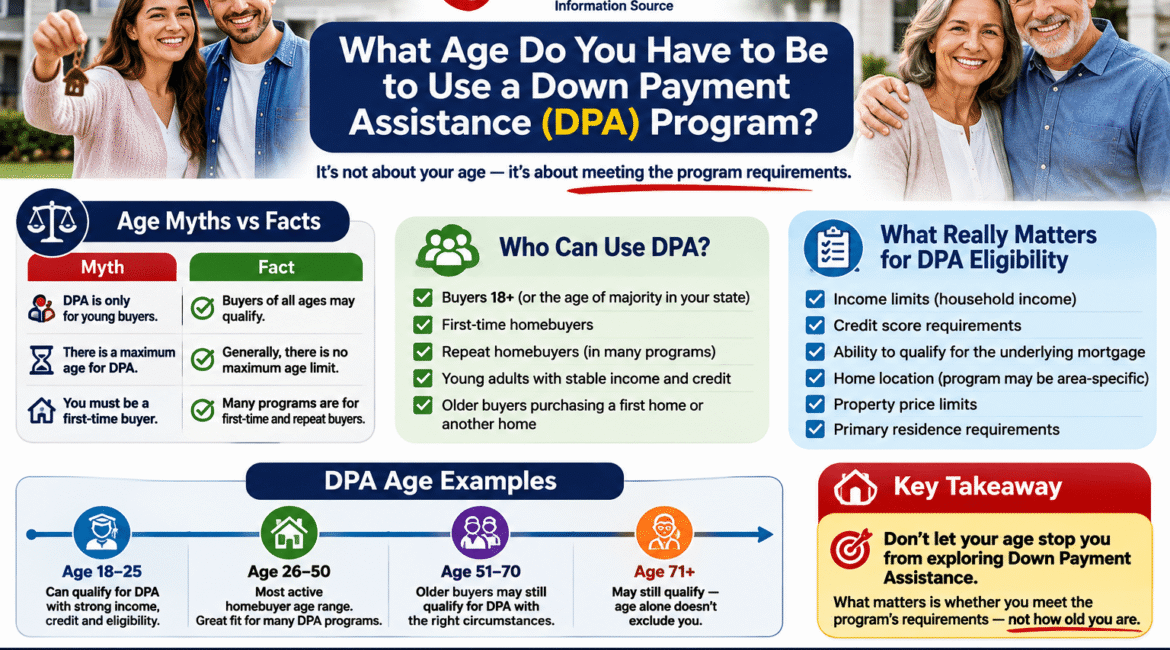
In most cases, Down Payment Assistance (DPA) programs do not have a maximum age limit. Instead, eligibility is generally based on factors such as income, credit, the mortgage program being used, property location, purchase price, occupancy, and the individual DPA program’s requirements.
However, buyers generally must be old enough to legally enter into the mortgage and other contractual obligations associated with purchasing a home. In most situations, that means being at least 18 years old, although the legal age and contractual requirements can vary by state and circumstance.

So whether you’re buying your first home at 20, 35, 55, or 70, your age by itself generally does not prevent you from exploring DPA opportunities.
Is There a Minimum Age for Down Payment Assistance?
DPA programs are generally designed to help eligible homebuyers overcome some of the upfront financial barriers to purchasing a home.
The programs themselves may not necessarily establish a specific minimum age. Instead, the practical issue is whether the buyer can legally enter into the purchase contract, mortgage, DPA agreement, and other required documents.
For most adult homebuyers, this isn’t an issue.
A buyer who is 18 or older may potentially qualify for DPA if they can also satisfy the requirements of the mortgage lender and assistance program.
However, being 18 doesn’t automatically mean you’ll qualify.
The borrower still needs to qualify for the underlying mortgage and satisfy the requirements of the DPA program.
Is There a Maximum Age for DPA?
Generally, there is no standard maximum age for Down Payment Assistance.
Someone purchasing a home later in life may potentially qualify for assistance just like a younger homebuyer.
For example, a buyer who is 60 years old could potentially qualify for the same DPA opportunity as a 30-year-old buyer if both satisfy the applicable program requirements.
The important factors usually involve financial and program eligibility—not whether someone is considered young or old.
This means older buyers shouldn’t automatically assume:
“Down Payment Assistance is only for young people.”
It isn’t.
Is DPA Only for Young First-Time Homebuyers?
This is a common misconception.
When people hear terms such as first-time homebuyer assistance, they sometimes picture someone in their 20s purchasing their first home.
But “first-time homebuyer” is generally a program definition, not an age category.
Depending on the particular program, someone could potentially qualify as a first-time homebuyer even if they owned a home many years ago.
Many housing programs use a definition based on whether the buyer has had an ownership interest in a principal residence during a specified previous period—commonly three years—but definitions and exceptions vary by program.
That means someone in their 40s, 50s, 60s, or beyond could potentially meet a particular program’s first-time homebuyer definition.
And some DPA programs don’t require first-time homebuyer status at all.
What Matters More Than Your Age?
Instead of focusing primarily on age, buyers exploring DPA should pay attention to the factors that actually determine eligibility.
Your Income
Many DPA programs establish household or qualifying income limits.
The maximum income permitted may depend on the program, county, household size, area median income, or other factors.
Some programs target low- and moderate-income households, while others have considerably broader income limits.
Your Credit
DPA programs and the underlying mortgage may have minimum credit-score requirements.
The minimum can vary depending on the assistance program and whether you’re financing the property with FHA, VA, USDA, conventional, or another eligible mortgage product.
Your Ability to Qualify for the Mortgage
DPA doesn’t replace mortgage qualification.
You still generally need to qualify for the first mortgage that will finance the home.
Your lender may evaluate your income, employment, assets, debts, credit history, and other financial information.
Think of DPA as assistance with eligible upfront costs—not a substitute for qualifying for the mortgage.
Where You’re Buying
Location can be extremely important.
Some assistance programs are statewide, while others may only be available in a particular county, city, municipality, or designated geographic area.
A program available for one property might not be available for another property a few miles away.
The Price of the Home
Many DPA programs establish maximum purchase prices or mortgage amounts.
Even if your income and credit qualify, purchasing a property above the program’s permitted limit could make the transaction ineligible.
How You’ll Use the Property
Many DPA programs require the property to become the buyer’s primary residence.
Investment properties and vacation homes may therefore be excluded from many programs.
Always check the requirements of the specific program you’re considering.
Can an 18-Year-Old Use DPA?
Potentially, yes.
An 18-year-old who is legally able to enter into the transaction and satisfies the applicable mortgage and DPA requirements could potentially receive Down Payment Assistance.
The more significant challenge for a very young buyer may be establishing sufficient qualifying income, employment history, credit, and overall mortgage eligibility.
But being young by itself doesn’t necessarily disqualify someone.
A young adult who has stable employment, qualifying income, acceptable credit, and meets the program requirements could be an excellent candidate to explore DPA.
Can Someone in Their 60s or 70s Receive DPA?
Potentially, yes.
There isn’t a universal rule saying that Down Payment Assistance stops being available when someone reaches a particular age.
Older buyers may still qualify based on the same applicable program and mortgage requirements.
For example, a person who rents for many years and decides to purchase a primary residence after retirement shouldn’t automatically assume that DPA is unavailable because of age.
The person’s qualifying income and financial circumstances would still need to meet the applicable mortgage and program requirements.
What About Retirement Income?
Older borrowers sometimes assume they must be actively employed to qualify for a mortgage or DPA.
That isn’t necessarily the case.
Depending on the mortgage and program requirements, qualifying income could potentially include eligible sources such as Social Security, pension income, retirement distributions, or other acceptable income.
The lender must determine whether the income satisfies the requirements of the mortgage being used, while the DPA administrator determines whether the borrower satisfies its program requirements.
This is another reason working with a mortgage professional familiar with DPA can be helpful.
Does Your Age Affect How Long Your Mortgage Can Be?
Another misconception is that an older borrower must automatically take a shorter mortgage.
Mortgage lending is subject to fair-lending and other applicable laws, and age generally cannot be used to improperly discriminate against an applicant.
A qualified older borrower may potentially obtain a standard mortgage term if the borrower satisfies the applicable requirements.
The important issue is the borrower’s ability to qualify for the financing—not simply their age.
What If You’re Under 18?
Buying real estate and obtaining mortgage financing as a minor can involve significant legal and contractual issues.
Because mortgage and DPA transactions require legally enforceable agreements, someone under the age of majority generally cannot approach the transaction in the same manner as an adult borrower.
The laws regarding minors, contracts, emancipation, guardianship, trusts, and property ownership can also vary by state.
If the potential buyer is under 18, the situation should be reviewed individually with appropriate mortgage and legal professionals rather than assuming normal adult DPA eligibility applies.
Don’t Confuse Age With First-Time Homebuyer Status
These are two completely different concepts.
Age asks: How old are you?
First-time homebuyer status asks: Do you satisfy the program’s definition of a first-time buyer?
A 21-year-old isn’t automatically a first-time homebuyer under every possible program.
Likewise, a 65-year-old isn’t automatically excluded from being considered one.
Eligibility depends on the program’s actual definition and the buyer’s previous ownership history.
DPA Isn’t Just for One Generation
One of the biggest misconceptions surrounding Down Payment Assistance is that these programs exist exclusively for young buyers just starting their careers.
Homebuyers come from many different stages of life.
Someone might purchase a first home at 22.
Another person might spend decades renting and purchase at 48.
Someone else may have owned a home years ago, returned to renting, and decide to purchase again at 62.
Each buyer’s circumstances are different.
DPA eligibility should be evaluated based on the program requirements—not assumptions about what a typical DPA buyer looks like.
Questions to Ask When Exploring DPA
Instead of asking only, “Am I the right age?”, consider asking:
Do I meet the program’s income requirements?
Does my credit meet the applicable requirements?
Do I qualify for the underlying mortgage?
Is the program available where I want to purchase?
Does the property qualify?
Is there a maximum purchase price?
Do I have to be a first-time homebuyer?
Does the home have to be my primary residence?
Is the assistance a grant, forgivable loan, deferred loan, or repayable loan?
Are funds currently available?
Those questions are usually far more important in determining whether DPA could work for you.
The Bottom Line
So, what age do you have to be to use Down Payment Assistance?
For most traditional home-purchase situations, the buyer generally needs to be an adult who can legally enter into the mortgage and related agreements—commonly 18 or older, subject to applicable state law and program requirements.
But there generally isn’t a universal maximum age for DPA.
Whether you’re 18, 28, 48, 68, or older, don’t automatically rule yourself out.
What matters is whether you qualify for the mortgage and satisfy the requirements of the specific assistance program available for your transaction.
Homeownership doesn’t have a single “right age,” and neither does Down Payment Assistance.
If you’re considering purchasing a home, explore the DPA programs available in your area and determine which opportunities may fit your particular circumstances.
Learn more about Down Payment Assistance and explore your options at DownAid.com.
DownAid.com is an informational resource. Down Payment Assistance eligibility, age requirements, income limits, first-time homebuyer definitions, credit requirements, property requirements, funding availability, and other terms vary by program and may change. Information provided is not a commitment to lend or a guarantee of eligibility or assistance. Always verify current requirements with the applicable program administrator and your mortgage professional.