Down Payment Assistance (DPA) can help eligible homebuyers overcome one of the biggest obstacles to purchasing a home: coming up with the money needed for the down payment and, in some cases, closing costs.
But what if you’re not purchasing a home solely to live in?

A common question is:
“Can I use Down Payment Assistance to purchase an investment property?”

In most cases, traditional DPA programs are designed for owner-occupied primary residences—not properties purchased strictly as investments.
That means you generally cannot use standard homebuyer DPA to purchase a rental property that you have no intention of occupying.
However, there is an important distinction that creates opportunities for some buyers:
Buying a property that produces rental income is not necessarily the same thing as buying an investment property.
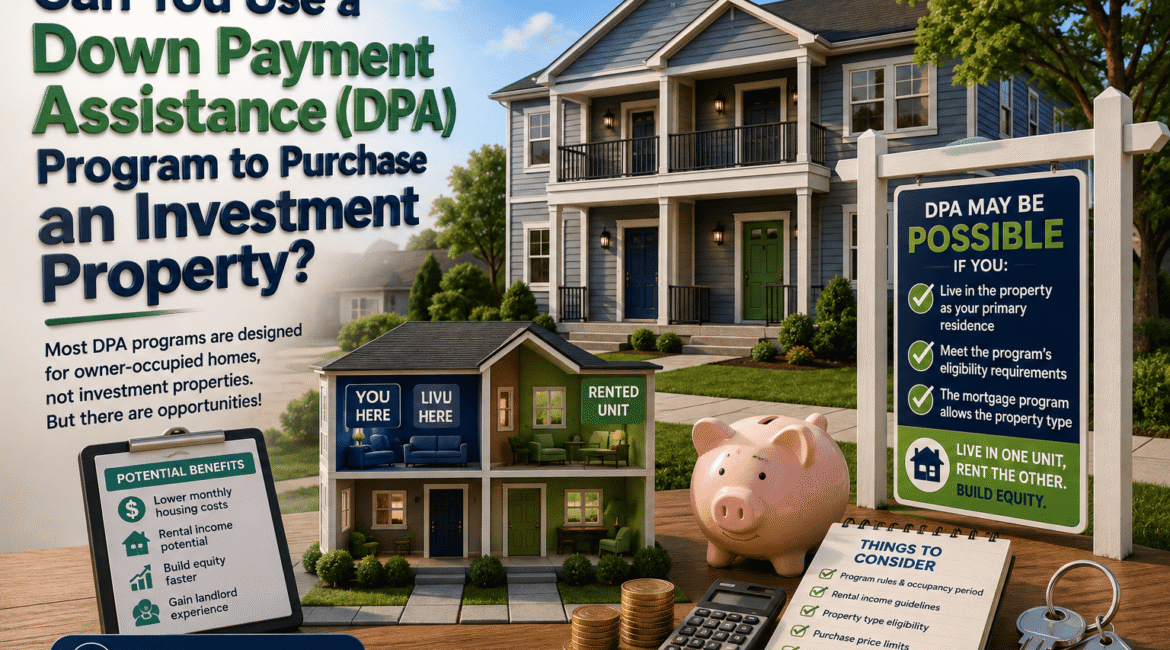
For example, an eligible buyer may be able to purchase a duplex, triplex, or four-unit property with DPA, live in one unit as their primary residence, and rent the remaining units—if the mortgage and DPA program both permit it.
That distinction can completely change the conversation.
Why Most DPA Programs Require a Primary Residence
Down Payment Assistance programs are generally intended to promote homeownership, particularly among buyers who can afford the ongoing costs of owning a home but need help with the upfront expenses.
Because of that purpose, many programs require the buyer to occupy the property as their principal or primary residence.
The assistance isn’t generally intended to subsidize the acquisition of traditional rental properties for investors.
A typical DPA program may therefore require you to:
Purchase the property as your primary residence
Move into the property within a specified period
Maintain the property as your principal residence for a required period
Certify your intention to occupy the home
The exact requirements vary by program.
What Is Considered an Investment Property?
For mortgage purposes, an investment property is generally real estate purchased primarily to generate income, appreciation, or both without the borrower occupying it as their principal residence.
Examples could include:
- A single-family home purchased exclusively to rent to tenants.
- A condominium purchased as a rental.
- A property purchased for short-term rental use.
- A duplex where the buyer rents both units and lives somewhere else.
- A home purchased primarily to renovate and resell.
- A second property purchased exclusively for investment purposes.
Traditional homebuyer DPA generally isn’t designed for these transactions.
If you’re purchasing a property strictly as an investment, you’ll typically need to explore financing designed for investment properties rather than standard homebuyer assistance.
But What If You Live in the Property?
This is where things get interesting.
A property can generate rental income and still be your primary residence.
Suppose you purchase a duplex.
You live in Unit A.
You rent Unit B.
From a practical standpoint, you have become both a homeowner and a landlord.
But because you actually occupy one of the units as your primary residence, the transaction may potentially qualify as an owner-occupied purchase rather than a traditional investment-property purchase.
Depending on the mortgage and DPA program, this could open the door to assistance.
The House-Hacking Opportunity
You may hear the term “house hacking” used to describe this strategy.
House hacking generally means purchasing a property, living in part of it, and using income from another portion of the property to help offset housing expenses.
A common example is purchasing a two- to four-unit property and living in one unit while renting the others.
For an eligible buyer, the combination can potentially be powerful:
Down Payment Assistance + Owner-Occupied Multifamily Property + Rental Income
Instead of using DPA to purchase a traditional investment property, the buyer is using DPA to purchase a primary residence that also has income-producing potential.
However, this only works when the underlying mortgage and DPA program permit the property type and transaction.
Can You Use DPA to Buy a Duplex?
Potentially, yes.
Some DPA programs may allow eligible two-unit properties when the borrower occupies one unit as their primary residence.
But not every program permits multifamily properties.
A particular DPA might only allow one-unit single-family residences, condominiums, or townhomes.
Another could allow two- to four-unit properties.
The answer therefore isn’t simply:
“DPA works on duplexes.”
The correct answer is:
“Some DPA programs may allow an owner-occupied duplex if both the DPA program and first mortgage permit it.”
What About a Triplex or Fourplex?
The same concept can potentially apply.
Certain mortgage programs permit eligible borrowers to purchase owner-occupied properties containing up to four residential units.
If your DPA program also allows that property type, you may potentially use assistance while occupying one unit and renting the others.
This can provide an interesting path for buyers who want to become homeowners while also beginning to build a real estate portfolio.
But qualification can become more complicated.
The lender may need to evaluate rental income, property expenses, appraisal information, reserves, mortgage-program requirements, and other factors.
The DPA program may impose additional restrictions.
Can Rental Income Help You Qualify?
Potentially.
Depending on the mortgage program and circumstances, eligible rental income from additional units may be considered when determining mortgage qualification.
For example, someone purchasing an owner-occupied duplex may potentially be able to use a portion of qualifying rental income from the second unit.
However, you should never assume that 100% of the expected rent will be used to qualify.
Mortgage programs have specific rules for calculating acceptable rental income.
The lender will determine how much, if any, can be considered based on the applicable underwriting requirements.
This can make owner-occupied multifamily financing especially interesting for some buyers, but the numbers need to be reviewed before making an offer.
DPA Doesn’t Change the Occupancy Requirement
One important point deserves special attention.
You can’t simply tell the lender and DPA administrator that you’re purchasing a primary residence in order to obtain favorable financing and assistance if you actually intend to use the property exclusively as an investment.
Your stated occupancy must reflect your genuine intention.
If a program requires owner occupancy, you need to satisfy that requirement.
Misrepresenting occupancy on a mortgage application or DPA application can have serious consequences.
If your intention is to purchase a property strictly as an investment, tell your mortgage professional that from the beginning so the appropriate financing options can be evaluated.
Can You Move Out Later and Keep the Property as a Rental?
Potentially—but this is where the DPA terms become extremely important.
Some buyers may legitimately purchase a home as their primary residence, live there for a period, and later decide to move.
Whether the property can then become a rental without affecting the DPA depends on the assistance program’s requirements.
For example, a forgivable DPA program might require you to occupy the property as your primary residence for five years.
Moving out after two years could potentially trigger repayment.
A deferred DPA loan might have different rules.
A grant could have another set of requirements.
Therefore, if you think you might eventually convert the home into a rental, ask:
How long am I required to occupy the property?
What happens to my DPA if I move out?
Does converting the property to a rental trigger repayment?
Will any remaining forgivable balance become due?
These questions should be answered before closing, not after you’ve already decided to move.
What If You Buy a Home With an Accessory Dwelling Unit?
An Accessory Dwelling Unit (ADU) can create another potential scenario.
An ADU might be a detached guest house, converted garage, backyard cottage, or separate living area associated with the primary residence.
Depending on the property, mortgage program, local requirements, and DPA rules, a buyer may potentially purchase an eligible primary residence containing an ADU.
The buyer would still occupy the property as required.
Whether rental income from the ADU can be considered for mortgage qualification is a separate underwriting question.
Again:
Property eligibility + Mortgage eligibility + DPA eligibility all need to work together.
What About Renting Out a Bedroom?
Purchasing a primary residence with DPA doesn’t necessarily mean no one else can ever live in the property.
However, whether you can rent rooms—and whether any boarder or rental income can be used for qualification—depends on the mortgage and DPA requirements.
The key distinction remains your occupancy.
If the property is genuinely your primary residence and you satisfy all program requirements, having another occupant isn’t necessarily the same as purchasing a traditional investment property.
But don’t assume anticipated roommate income will automatically help you qualify for the mortgage.
Can DPA Be Used for a Vacation Rental or Airbnb?
Generally, traditional DPA is not intended to finance properties purchased primarily as vacation rentals or short-term rental investments.
If your primary intention is to purchase a property that will operate as an Airbnb, vacation rental, or other short-term rental while you maintain your principal residence somewhere else, standard homebuyer DPA will generally not be the appropriate financing source.
Additionally, short-term rentals may be subject to local zoning, condominium, HOA, insurance, and mortgage restrictions.
Buyers considering this strategy should evaluate all of those issues before purchasing.
Can You Use DPA to Flip a House?
Generally, no.
A property purchased primarily to renovate and quickly resell for profit is an investment transaction rather than a traditional owner-occupied home purchase.
DPA programs intended to promote homeownership generally aren’t designed to finance house-flipping activity.
There may be specialized investment or renovation financing options available, but those are different from typical homebuyer DPA programs.
What About Buying a Home and Renting It Immediately?
If the DPA program requires the property to be your primary residence, purchasing the home and immediately renting the entire property would generally conflict with that requirement.
The same applies to the first mortgage.
Owner-occupied mortgage financing and DPA are based on the expectation that the borrower will actually occupy the property according to the applicable requirements.
If your intention from the beginning is to rent the entire property, you should explore investment-property financing instead.
Why an Owner-Occupied Multifamily Property Can Be Worth Exploring
For the right buyer, purchasing an eligible two- to four-unit property can potentially create several benefits.
You may be able to:
Become a homeowner
Receive eligible Down Payment Assistance
Live in one unit
Rent the other unit or units
Potentially use eligible rental income when qualifying
Build equity in a larger property
Gain experience as a landlord
Create a foundation for future real estate investing
This doesn’t mean the strategy is right for everyone.
Being a landlord creates additional responsibilities, expenses, risks, maintenance obligations, and legal considerations.
But for buyers who understand those responsibilities, it may provide an alternative way to approach homeownership.
Don’t Forget the Additional Costs of Multifamily Ownership
Rental income can make an owner-occupied multifamily property attractive, but don’t focus exclusively on the rent.
A landlord may face additional costs involving:
Property maintenance
Repairs
Vacancies
Utilities
Insurance
Property management
Tenant-related expenses
Local licensing or registration
Unexpected capital improvements
You should determine whether you can comfortably afford the property even when unexpected expenses occur.
DPA can help you get into the home, but it doesn’t eliminate the financial responsibilities that come after closing.
Not Every DPA Program Allows Every Property Type
This is one of the most important points.
Even if your mortgage permits an owner-occupied four-unit property, your DPA program might not.
Conversely, a DPA program may permit a particular property type, but the first mortgage could impose additional qualification requirements.
Before making an offer, verify:
Does the DPA program permit 2–4 unit properties?
Does my mortgage program permit the property?
Can rental income be considered?
How will rental income be calculated?
Are there additional reserve requirements?
Are there maximum purchase-price limits?
Does the property fall within an eligible location?
How long must I occupy the property?
Getting these answers early can prevent major problems later.
Investment Property vs. Income-Producing Primary Residence
Here’s the distinction buyers should remember:
Traditional Investment Property
You purchase the property primarily as an investment and do not occupy it as your principal residence.
Traditional homebuyer DPA: Generally not available.
Income-Producing Primary Residence
You purchase an eligible property, live in it as your principal residence, and potentially rent another unit or permitted portion of the property.
DPA: Potentially available, depending on the program.
That difference can open opportunities that buyers may not realize exist.
Questions to Ask Before Using DPA on a Multifamily Home
If you’re interested in combining DPA with an owner-occupied multifamily property, ask your mortgage professional:
Does this DPA allow duplexes, triplexes, or fourplexes?
Which mortgage programs can I combine with the assistance?
How much rental income can potentially be considered?
Will I need landlord experience?
Are additional reserves required?
Does the DPA have an occupancy period?
What happens if I move out later?
Can I eventually convert the entire property to a rental?
Would doing so trigger DPA repayment?
Are there special appraisal requirements?
Does the program have different purchase-price limits for multifamily properties?
A knowledgeable mortgage professional can help determine whether the pieces fit together.
Could DPA Be the First Step Toward Real Estate Investing?
For some buyers, potentially.
DPA isn’t generally designed as an investment-property financing tool.
But purchasing an eligible owner-occupied multifamily property can potentially allow someone to become a homeowner while also gaining exposure to rental-property ownership.
Imagine purchasing a duplex with eligible assistance.
You occupy one side and rent the other.
Over time, you build equity, learn how to manage a property, and potentially receive rental income to help offset housing expenses.
Years later—after satisfying all applicable mortgage and DPA occupancy requirements—you may decide to purchase another primary residence and retain the original property, if permitted.
That could potentially turn the first home into part of a longer-term real estate strategy.
But the original intent to occupy the property must be genuine, and all mortgage and DPA requirements must be satisfied.
The Bottom Line
Can you use Down Payment Assistance to purchase an investment property?
For a traditional non-owner-occupied investment property, generally no.
Most homebuyer DPA programs are designed to help eligible borrowers purchase a primary residence.
But that doesn’t necessarily mean a property can’t generate income.
Depending on the program, you may potentially be able to use DPA to purchase an owner-occupied duplex, triplex, fourplex, or other eligible property, live in part of it, and rent the remaining permitted space.
That creates an important opportunity:
You don’t necessarily need to choose between becoming a homeowner and beginning to think like a real estate investor.
For the right buyer and the right program, an owner-occupied income-producing property could potentially accomplish both.
Before making an offer, verify the occupancy rules, eligible property types, rental-income guidelines, repayment requirements, and DPA restrictions with an experienced mortgage professional and the applicable DPA administrator.
Explore Down Payment Assistance programs and learn more about potential homeownership opportunities at DownAid.com.
DownAid.com is an informational resource and does not determine program eligibility or provide the underlying DPA financing. DPA availability, eligible property types, occupancy requirements, rental-income rules, assistance amounts, repayment requirements, funding availability, mortgage compatibility, and other terms vary by program and may change. Always verify current requirements with the applicable program administrator and your mortgage professional. Rental-property ownership may also involve tax, legal, insurance, licensing, and landlord responsibilities that should be reviewed with the appropriate professionals.