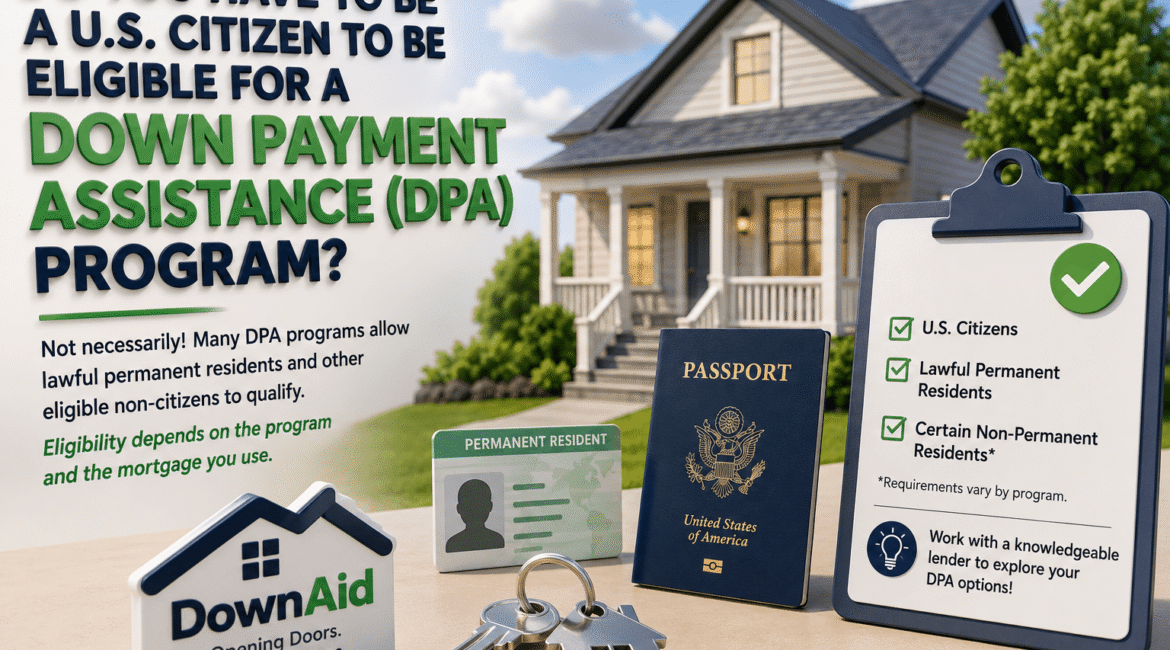
One of the questions prospective homebuyers frequently have when exploring Down Payment Assistance is:
“Do I have to be a U.S. citizen to qualify for DPA?”

The answer is not necessarily.
U.S. citizenship is not a universal requirement for every Down Payment Assistance (DPA) program. Depending on the particular program, certain non-U.S. citizens may be eligible for assistance.

However, this is an area where the details matter considerably.
Eligibility can depend on two separate sets of requirements:
1. The requirements of the mortgage you’re using to purchase the home.
2. The citizenship or residency requirements of the specific DPA program providing the assistance.
A borrower could potentially qualify for the underlying mortgage but not a particular DPA program—or qualify under a DPA program’s residency rules but not satisfy the requirements of the mortgage being paired with it.
For that reason, buyers should never assume that citizenship—or the lack of citizenship—automatically determines whether DPA is available.
Citizenship and Legal Residency Are Not the Same Thing
One of the first things to understand is the difference between being a U.S. citizen and being a lawful resident or otherwise eligible non-citizen borrower.
Someone doesn’t necessarily need to be a U.S. citizen to qualify for a mortgage.
For example, under current Fannie Mae conventional guidelines, lawful permanent and lawful non-permanent residents may be eligible for qualifying conventional mortgages under the same terms available to U.S. citizens, subject to the lender verifying legal presence and satisfying the remaining underwriting requirements.
Freddie Mac similarly states that non-U.S. citizens lawfully residing in the United States as permanent or nonpermanent resident aliens may be eligible for a mortgage on the same terms as U.S. citizens.
That means:
Not being a U.S. citizen does not automatically mean you cannot purchase a home or potentially benefit from DPA.
But the assistance program itself must also permit your residency status.
U.S. Citizens
U.S. citizens will generally satisfy the citizenship component of programs that restrict eligibility to citizens and certain eligible residents.
Of course, citizenship alone doesn’t qualify someone for DPA.
A U.S. citizen may still need to satisfy requirements involving income, credit, first-time homebuyer status, property location, purchase price, occupancy, household size, mortgage type, and other program-specific criteria.
Think of citizenship or residency status as one potential eligibility requirement among many.
Lawful Permanent Residents
Lawful permanent residents—often referred to as green card holders—may potentially qualify for many mortgage and DPA programs.
For conventional financing, both Fannie Mae and Freddie Mac currently permit qualifying lawful permanent residents under their applicable non-citizen borrower policies.
FHA also currently permits lawful permanent residents to obtain FHA-insured financing under the same general requirements, terms, and conditions applicable to U.S. citizens, provided the required permanent-residency documentation is established.
However, mortgage eligibility doesn’t automatically establish DPA eligibility.
The individual DPA program must still allow lawful permanent residents.
What About Non-Permanent Residents?
This is where buyers need to be particularly careful because requirements can differ significantly depending on the mortgage program.
For certain conventional mortgages, lawful non-permanent residents may still be eligible.
Fannie Mae currently permits mortgages for lawful non-permanent residents under the same general terms available to U.S. citizens, subject to its eligibility and documentation requirements. Freddie Mac has a similar policy for lawfully residing nonpermanent resident borrowers.
However, FHA rules are now different.
HUD changed FHA residency requirements effective May 25, 2025, eliminating FHA eligibility for non-permanent resident borrowers. FHA currently permits qualifying U.S. citizens, lawful permanent residents, and certain citizens of the Federated States of Micronesia, the Republic of the Marshall Islands, and the Republic of Palau under its specified requirements.
This illustrates why buyers shouldn’t rely on old articles, social-media posts, or general statements about non-citizen mortgage eligibility.
The mortgage program matters, and the rules can change.
Mortgage Eligibility and DPA Eligibility Are Two Different Questions
This is probably the most important concept for a non-citizen buyer to understand.
Imagine that a lawful non-permanent resident qualifies for conventional financing under applicable Fannie Mae requirements.
That answers the first question:
Can the borrower potentially qualify for the first mortgage?
Now there is a second question:
Will the DPA program accept a borrower with that particular residency status?
The answer could still be yes or no.
A state housing finance agency, city program, county program, nonprofit organization, employer program, or other DPA provider can have its own eligibility requirements.
Therefore:
Mortgage Eligible ≠ Automatically DPA Eligible
Both programs need to work together.
Why Do Citizenship Requirements Differ Between DPA Programs?
There isn’t one national DPA program with one universal set of rules.
Down Payment Assistance can come from many different sources, including state housing finance agencies, counties, municipalities, nonprofit organizations, housing authorities, employers, lenders, and other organizations.
Each program may be funded differently and governed by different requirements.
One DPA program might permit eligible U.S. citizens and lawful permanent residents.
Another could potentially permit additional categories of lawfully present borrowers.
Another might have more restrictive requirements because of the source of its funding.
This is why the correct question isn’t simply:
“Can non-citizens get DPA?”
A better question is:
“Which DPA programs are available to someone with my specific residency status?”
Documentation May Be Required
Non-U.S. citizen borrowers should expect the lender and potentially the DPA administrator to request documentation establishing their eligibility.
The exact documentation depends on the borrower’s status, mortgage product, lender requirements, and DPA program.
For example, Fannie Mae requires lenders to determine that a non-U.S. citizen borrower is legally present in the country, while giving the lender responsibility for determining appropriate documentation based on the individual circumstances.
Fannie Mae also requires borrowers to have an acceptable taxpayer identification number under its applicable requirements.
The important point is:
Don’t wait until you’re under contract to find out what documentation you’ll need.
Have your mortgage professional review your situation early.
Can Green Card Holders Receive DPA?
Potentially, yes.
Lawful permanent residents may qualify for numerous mortgage products and may also qualify for DPA programs that permit permanent residents.
The borrower must still satisfy all of the other program requirements.
Those requirements might include income limits, minimum credit scores, purchase-price limits, primary-residence requirements, homebuyer education, eligible property locations, and other criteria.
Being a green card holder doesn’t guarantee assistance—but it also shouldn’t automatically cause you to assume that DPA isn’t available.
Can Someone With a Work Visa Receive DPA?
Potentially, depending on the mortgage and DPA program.
Certain lawful non-permanent residents may qualify for conventional financing under Fannie Mae or Freddie Mac requirements.
However, the DPA program must separately permit that residency category.
And as noted above, current FHA rules no longer permit non-permanent residents for FHA-insured financing.
Therefore, someone with a temporary immigration status shouldn’t assume that because one mortgage product is unavailable, every mortgage or DPA opportunity is unavailable.
The entire scenario needs to be evaluated.
What About DACA Recipients or Other Immigration Categories?
These situations require a program-specific review.
Immigration categories, legal-presence requirements, mortgage guidelines, and DPA requirements can be complicated and may change.
Rather than attempting to categorize yourself based on an online article, provide your documentation to a knowledgeable mortgage professional who can determine which mortgage options may apply and then identify DPA programs compatible with those options.
If necessary, questions regarding immigration status itself should be addressed with a qualified immigration attorney.
A mortgage professional can determine lending eligibility but should not provide legal advice regarding someone’s immigration status.
What About ITIN Borrowers?
An Individual Taxpayer Identification Number (ITIN) by itself does not automatically establish eligibility for a particular DPA program or mortgage.
Some specialized mortgage programs may serve ITIN borrowers, but DPA compatibility can be much more limited and will depend entirely on the particular assistance program and financing being used.
Interestingly, Fannie Mae’s current general borrower eligibility requirements state that borrowers must have a valid Social Security number or ITIN in addition to meeting applicable legal-residency and documentation requirements. In other words, the tax identification number is only one part of the eligibility analysis.
If you’re an ITIN borrower, it’s especially important to determine DPA compatibility before entering into a purchase contract.
Does the DPA Program Have to Match the Mortgage?
Absolutely.
A DPA program doesn’t operate independently from your first mortgage.
The assistance must generally be acceptable with the mortgage product being used.
For example, a particular DPA program might be compatible with FHA and certain conventional loans but impose different residency requirements for each.
Another DPA program may only work with a specific first-mortgage product.
Your lender needs to verify both sides of the transaction.
Think of it as two pieces of a puzzle:
Your First Mortgage + Your DPA Program = A Compatible Financing Structure
If the two pieces don’t fit together, another mortgage or DPA option may need to be considered.
Other DPA Requirements Still Apply
Even when your citizenship or residency status is acceptable, you still need to qualify under the program’s other requirements.
These could include:
Income limits – Your household or qualifying income may need to fall below a specified maximum.
Credit requirements – Minimum credit scores may apply.
Debt-to-income requirements – Your mortgage must remain affordable under applicable guidelines.
Purchase-price limits – The home may need to fall below a program maximum.
Property location – Some programs are restricted to particular cities, counties, states, or designated areas.
Primary residence – Many DPA programs require you to occupy the home as your principal residence.
First-time homebuyer requirements – Some programs require first-time buyer status, while others don’t.
Homebuyer education – Completion of an approved course may be required.
Funding availability – Even an eligible borrower can’t receive assistance from a program that currently has no funds available.
Don’t Assume You Don’t Qualify
One of the unfortunate consequences of misunderstanding DPA requirements is that potentially eligible buyers may never investigate their options.
Someone might hear:
“You have to be a U.S. citizen to get homebuyer assistance.”
That statement is too broad.
Some DPA programs may indeed impose citizenship requirements.
Others may permit lawful permanent residents or other qualifying non-citizens.
And conventional mortgage rules currently allow certain lawful non-U.S. citizens to qualify under the same general terms as citizens.
The only reliable approach is to evaluate the actual programs available for your circumstances.
Don’t Assume You Qualify Either
The opposite mistake is equally important.
Qualifying for a mortgage as a non-U.S. citizen doesn’t automatically mean every DPA program is available to you.
For example:
“Fannie Mae allows my residency status, so I can use any conventional DPA program.”
That conclusion isn’t necessarily correct.
The DPA provider may have additional requirements that are more restrictive than those of the underlying mortgage.
Always verify both.
Questions Non-U.S. Citizens Should Ask Before Applying for DPA
When speaking with a mortgage professional or DPA administrator, consider asking:
Does this DPA program require U.S. citizenship?
Are lawful permanent residents eligible?
Are lawful non-permanent residents eligible?
What documentation is required to establish eligibility?
Is my particular mortgage program compatible with this DPA?
Does my immigration or residency status satisfy the first mortgage requirements?
Are there income or household limits?
Do I need to be a first-time homebuyer?
Does the property need to be in a specific area?
Are there purchase-price limits?
Are funds currently available?
Is the assistance a grant, forgivable loan, deferred loan, or repayable loan?
Getting these answers early can help prevent problems after you’ve already found a home.
Explore DPA Before You Start Shopping
For non-U.S. citizen buyers, early preparation is especially important.
Ideally, determine both your mortgage eligibility and potential DPA eligibility before making an offer on a property.
That gives your mortgage professional time to review your documentation, determine which mortgage products may be available, research compatible assistance programs, and identify any additional requirements.
Once you’ve found the right combination, you can begin shopping with a much clearer understanding of your financing.
The Bottom Line
No, you don’t necessarily have to be a U.S. citizen to qualify for Down Payment Assistance.
Some DPA programs may allow lawful permanent residents and, depending on the program and underlying mortgage, certain other eligible non-U.S. citizens.
However, there is no universal citizenship rule covering every DPA program.
Your eligibility depends on the requirements of both:
The mortgage financing your home
AND
The Down Payment Assistance program helping with the purchase.
Current conventional guidelines from Fannie Mae and Freddie Mac permit certain lawful permanent and non-permanent residents to obtain eligible mortgages under generally the same terms as U.S. citizens, while current FHA policy is more restrictive and no longer permits non-permanent resident borrowers.
So don’t automatically assume you’re disqualified simply because you’re not a U.S. citizen.
Your residency status may change which programs are available to you—but it doesn’t necessarily close the door to Down Payment Assistance or homeownership.
Explore Down Payment Assistance programs and learn more about potential options at DownAid.com.
DownAid.com is an informational resource and does not make immigration determinations, determine DPA eligibility, or provide the underlying DPA financing. Citizenship and residency requirements, immigration documentation, mortgage eligibility, DPA eligibility, funding availability, income limits, assistance amounts, and program terms vary and may change. Always verify current requirements with the applicable DPA administrator and mortgage professional. Questions concerning an individual’s immigration status should be directed to a qualified immigration professional.