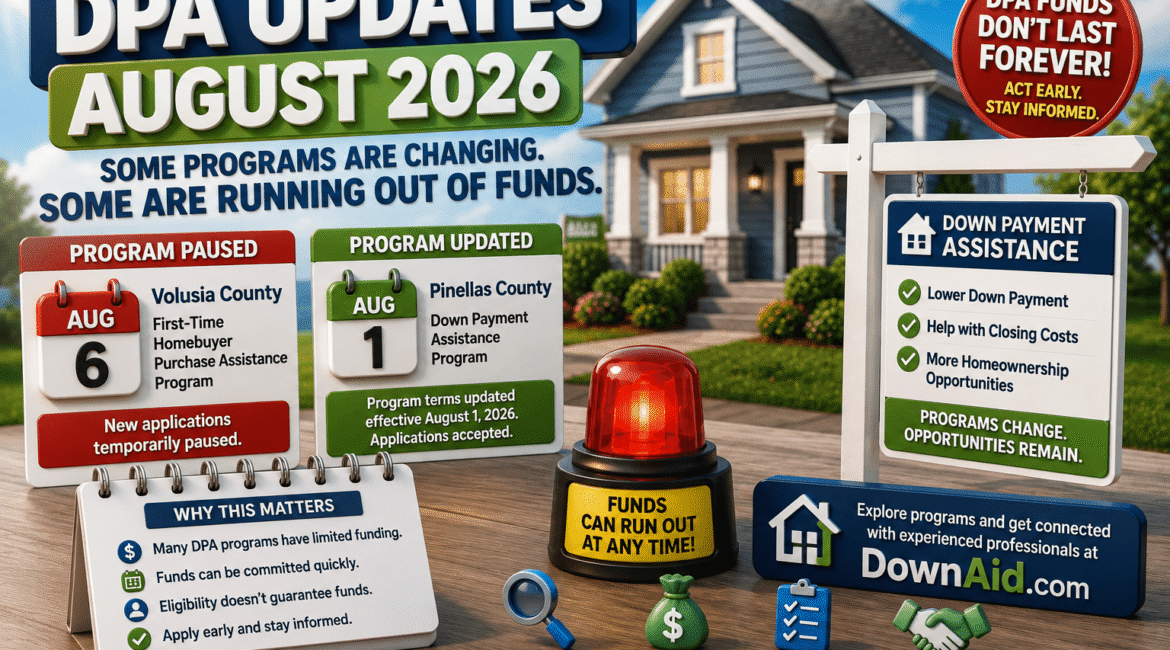
If you’re planning to purchase a home using Down Payment Assistance (DPA), there is an important message for August 2026:
Don’t assume the program available today will still be available when you find your home.

Down Payment Assistance programs across Florida and throughout the country are constantly changing. New funding can become available, program guidelines can be updated, assistance amounts can change, applications can be temporarily paused, and some programs can stop accepting new applicants when their available funds have been committed.
That makes timing increasingly important for homebuyers.

A buyer who researches DPA today and waits several months to purchase may discover that the program has changed—or that its funding is no longer available.
At the same time, another program may have opened or received additional funding.
DPA is not a static marketplace. It changes throughout the year.
August 2026 Is a Good Example of How Quickly DPA Can Change
Recent developments demonstrate why buyers should verify program information rather than relying on an article, social-media post, or program list they found months ago.
In Florida, for example, Pinellas County’s Down Payment Assistance Program is currently accepting applications and notes that its program terms were updated effective August 1, 2026.
Meanwhile, Volusia County announced on August 6, 2026 that it was temporarily pausing new applications for its First-Time Homebuyer Purchase Assistance Program.
Those are two Florida counties—and two very different situations.
One program may be available while another nearby program may be paused.
That is exactly why asking simply:
“Does Florida have Down Payment Assistance?”
doesn’t tell you enough.
The better question is:
“Which programs are currently funded and accepting eligible buyers for the specific area where I want to purchase?”
DPA Funding Is Often Limited
One of the most important things homebuyers need to understand is that many DPA programs don’t have unlimited money.
A state, county, municipality, housing authority, nonprofit organization, or other program administrator may receive a specific allocation of funds.
Those funds can then be committed to eligible buyers.
Eventually, the available allocation may be exhausted.
When that happens, the program might:
Stop accepting new applications
Create a waiting list
Temporarily pause reservations
Wait for another funding allocation
Reopen during a future funding cycle
or change the assistance being offered.
This means that meeting a program’s eligibility requirements doesn’t necessarily guarantee that assistance will be available when you’re ready to purchase.
Eligible Doesn’t Always Mean Funded
This distinction is extremely important.
Imagine that you meet every requirement for a particular DPA program.
Your income qualifies.
Your credit qualifies.
Your mortgage qualifies.
You’re purchasing in the correct area.
The property meets the requirements.
You complete the required homebuyer education.
You could be an excellent candidate for the program.
But if the program has exhausted its available funds before your assistance is properly reserved, there may be no assistance available to give you.
That’s why DPA buyers need to understand three different concepts:
Program Exists
Buyer Qualifies
Funding Is Available
You generally need all three to come together.
We’ve Already Seen How Quickly Major Programs Can Exhaust Funding
Florida’s Hometown Heroes Housing Program provides a good example of why buyers should take funding availability seriously.
Florida Housing reported that the program received $50 million for the 2025–2026 fiscal year. Those funds became available for participating lenders to reserve for qualified homebuyers on August 18, 2025.
By February 20, 2026, the entire $50 million had been fully committed.
In other words, a significant statewide allocation didn’t necessarily remain available throughout the entire year.
That history provides an important lesson for buyers considering any limited-funding DPA program:
If you’ve found a program that fits your situation, don’t assume the money will wait for you.
Some Programs Are Opening While Others Are Closing
The DPA landscape isn’t simply about programs running out of money.
New opportunities also appear.
For example, Miami-Dade announced its new Welcome H.O.M.E. (Housing Opportunities Made for Everyone) initiative in August 2026.
The initiative is designed to create additional pathways to affordable homeownership and includes access to down payment assistance resources for eligible buyers purchasing select newly constructed homes.
Applications are scheduled to open September 1, 2026, with the application period closing once 200 qualified applications are received.
That’s another excellent example of why buyers should actively monitor DPA opportunities.
While one program may pause because of funding or capacity, another may be preparing to open.
Some Programs Explicitly Warn That Funding Can Disappear
This isn’t just theoretical.
Some DPA administrators explicitly tell applicants that availability depends on remaining funds.
For example, Louisville’s Down Payment Assistance Program announced an August 17, 2026 reopening and stated that applications would remain open as long as funding remains available.
The program also warns that an eligibility letter doesn’t guarantee funds will still be available when the buyer eventually finds a home.
That distinction is critical.
You might be:
Eligible for assistance
but not yet have:
Reserved assistance
Those are not necessarily the same thing.
A Program Can Be Available Today and Gone Tomorrow
This is one of the biggest challenges with DPA.
Homebuyers often begin by researching programs online.
They find a program advertising:
$10,000
$20,000
$35,000
or perhaps substantially more in certain local programs.
They mentally incorporate that assistance into their homebuying plan.
Then they spend several months repairing credit, saving money, obtaining a preapproval, or searching for a property.
By the time they finally sign a purchase contract, the program they planned to use may have changed.
The assistance amount could be different.
The income limits could have changed.
The interest rate structure could be different.
The program could be paused.
Or the funding could be exhausted.
That’s why DPA research should never be treated as a one-time event.
DPA Availability Should Be Checked at Multiple Stages
If you’re planning to purchase using assistance, funding should ideally be checked more than once.
When You Begin Planning
Identify programs that appear to match your situation.
This helps you understand potential income limits, credit requirements, property restrictions, first-time buyer requirements, and other eligibility criteria.
When You’re Ready for Mortgage Preapproval
Your mortgage professional should verify that the programs you’re considering are still active and compatible with your mortgage.
Before Making an Offer
Verify that the program is still accepting applications or reservations and determine the expected timeline.
When You Go Under Contract
Your lender should determine what needs to happen to reserve or secure the assistance for your transaction.
The important lesson is simple:
Yesterday’s availability doesn’t guarantee today’s funding.
What Does It Mean When Funds Are “Reserved”?
Depending on the DPA program, there may be an important difference between qualifying for assistance and having funds actually committed to your transaction.
Some programs allow a participating lender or administrator to reserve funds once certain requirements have been satisfied.
That reservation can be extremely important.
Think of it like this:
Potentially Eligible → Approved/Qualified → Funds Reserved → Closing
The exact process varies by program, but buyers should ask:
At what point is my assistance actually reserved for me?
Until you know the answer, don’t assume the funds are guaranteed.
Local Programs Can Change Even Faster
Statewide programs receive a lot of attention, but some of the best DPA opportunities can come from counties, cities, municipalities, housing authorities, and nonprofit organizations.
These programs may provide significant assistance.
For example, Pinellas County currently advertises an interest-free deferred loan of up to $75,000 for qualifying buyers under its program, subject to its eligibility requirements.
But local programs may also operate with smaller pools of funding.
That can make availability particularly important.
A program might accept applications until:
All funds are committed
A specific number of applications is reached
A fiscal-year allocation is exhausted
or a predetermined application deadline arrives.
“Applications Open” Doesn’t Necessarily Mean Unlimited Availability
This is another important distinction.
A website saying:
“Now Accepting Applications”
doesn’t mean an unlimited number of buyers can receive assistance.
Indian River County, for example, announced that applications for its 2026–27 SHIP-funded assistance would be accepted beginning August 1, 2026 and continue through June 30, 2027 or until all funds are encumbered, whichever occurs first.
That final phrase matters.
“Until all funds are encumbered.”
The calendar deadline may say June 2027, but the effective deadline could arrive much earlier if available funds are committed.
Why Are DPA Programs Running Out of Money?
There are several reasons.
Demand for Homebuyer Assistance Is High
Home prices remain challenging for many households, and accumulating enough cash for a down payment and closing costs can take years.
That creates significant demand for programs designed to reduce upfront expenses.
Programs Have Fixed Budgets
Many assistance programs receive a predetermined amount of money.
Once that allocation has been committed, the program can’t simply continue providing assistance indefinitely.
Larger Assistance Amounts Can Use Funding Faster
Suppose a program has $10 million available.
If the average buyer receives $10,000, theoretically that pool could assist many more households than if the average assistance amount were $50,000.
Larger individual awards can make programs extremely valuable—but can also consume available funding more quickly.
Local Housing Affordability Is Increasing Demand
In areas where home prices have increased significantly relative to household income, more buyers may need assistance to bridge the affordability gap.
Don’t Wait Until You Find the House
One of the biggest mistakes a potential DPA buyer can make is:
Find House → Sign Contract → Start Looking for DPA
A better strategy is:
Explore DPA → Review Eligibility → Get Mortgage Ready → Shop for Home → Verify Funding → Make Offer → Reserve Assistance → Close
This doesn’t guarantee assistance.
But it can significantly reduce the chance of discovering a problem after you’re already contractually committed to purchasing a property.
Don’t Build Your Entire Purchase Around Assistance That Isn’t Reserved
DPA can be powerful, but buyers should also understand their backup options.
Ask your mortgage professional:
What happens if this program runs out of money before I go under contract?
Could another DPA program work?
Could you reduce the purchase price?
Could seller contributions help?
Could lender credits help?
Could you contribute additional funds?
Would another mortgage product make sense?
Having a Plan B can prevent an unexpected funding change from ending your homebuying plans entirely.
One DPA Program Running Out Doesn’t Mean You’re Out of Options
This may be the most important message for homebuyers.
There isn’t just one Down Payment Assistance program.
There are programs administered by:
States
Counties
Cities and municipalities
Housing finance agencies
Nonprofit organizations
Employers
Lenders
and other organizations.
The fact that one program is paused, closed, or out of funds does not necessarily mean you have no DPA options.
Another program may have completely different eligibility requirements and funding.
This is one reason buyers benefit from working with professionals who understand multiple assistance options rather than relying on a single popular program.
Don’t Chase the Largest DPA Number
Seeing an advertisement for $50,000 or $75,000 of assistance can understandably get a buyer’s attention.
But the program offering the largest dollar amount isn’t automatically the best program.
You also need to consider:
Repayment requirements
Interest rates
Forgiveness periods
Occupancy requirements
Income limits
Property restrictions
Closing timelines
Mortgage compatibility
Future refinancing restrictions
and whether the funds are actually available.
A smaller grant or forgivable program could potentially be more valuable than a larger repayable second mortgage.
Look at the entire program—not just the headline number.
August 2026: What Buyers Should Do Right Now
If you’re considering purchasing a home with DPA during the remainder of 2026, now is a good time to review your options.
Don’t rely on a program list from January.
Don’t assume a social-media advertisement is still accurate.
Don’t assume that because your friend received assistance six months ago, the same program is still funded today.
And don’t assume you’re out of options because one program closed.
Instead:
Check current program availability.
Determine which programs match your location.
Review current income and purchase-price limits.
Confirm the mortgage programs that can be paired with the assistance.
Ask whether funding is currently available.
Ask when funds can actually be reserved.
Determine how much time the program needs to close.
That information gives you a much more realistic picture of your purchasing power.
DPA Should Be Treated as a Moving Target
Mortgage rates change.
Home prices change.
Income limits change.
Program guidelines change.
Funding changes.
DPA is no different.
The program that isn’t available today could receive additional funding later.
The program available today could be fully committed next month.
A new city or county initiative could launch.
An existing program could increase or decrease its assistance.
That means buyers and real estate professionals should treat DPA information as time-sensitive.
Always verify before relying on it.
The Bottom Line
As of August 2026, the Down Payment Assistance landscape continues to change.
Some programs are accepting new buyers.
Some have updated their guidelines.
Some are temporarily paused.
New programs are being introduced.
And programs operating with limited allocations can run out of available funds.
The lesson isn’t that buyers should panic or rush into purchasing a home.
The lesson is:
If you think you’ll need Down Payment Assistance, start exploring your options early.
Don’t wait until you’ve already found the perfect house to discover whether assistance is available.
And if the program you wanted has run out of funds, don’t automatically give up.
There may be another state, county, municipal, nonprofit, employer, or lender-supported program that fits your circumstances.
DPA availability changes. Your opportunity to become a homeowner doesn’t necessarily disappear with one program.
Visit DownAid.com to learn about Down Payment Assistance, explore potential programs, and request to be connected with experienced real estate and mortgage professionals who can help you investigate current options.
Program availability, funding, eligibility requirements, assistance amounts, income limits, purchase-price limits, interest rates, repayment terms, and guidelines can change at any time. DownAid.com is an informational resource and does not administer or provide DPA funds or mortgage financing. Availability should always be confirmed directly with the applicable program administrator and participating mortgage professional before making a financial or contractual decision.